
Category Archives: Uncategorized

Links: Supporting Scientific Innovation, Libraries and Abundance, Writing to Your Dissertation

Explorations of Style will be taking next week off; I have to travel for a conference and, first, to make that travel worthwhile, have to write the paper I will be presenting at the conference. The presentation is on the role this blog plays in my classroom teaching, so don’t imagine the lack of posts means I’m not still thinking about the blog all the time. I will return with something new—or at least something adapted from my presentation on blogging and teaching—on June 1st. See you then! I will leave you with a few weekly links.

Here is a great piece from Slate on the best model for funding innovative scientific work. Tim Harford offers a fascinating discussion of the relationship between funding—both public and private—and scientific progress.

While I don’t know much about libraries, I am sure that those of us who benefit from university libraries ought to listen to what librarians have to say about the sustainability of the current model of managing collections. Here is something from Barbara Fister, writing at Inside Higher Ed. I particularly like the way she uses a food analogy, stressing the need to think about sustainability even in the face of apparent abundance.

Finally, from McSweeney’s, here is someone’s letter to his dissertation. This letter is part of their series of ‘Open letters to people or entities who are unlikely to respond’. I am obliged, of course, to say that you would be better off writing your dissertation than writing to your dissertation. But I found this line funny: “You probably sense that I am a little frustrated, the way that I spend time with you every day but it’s never quality time, the way you are always on my mind but we never seem to get anywhere.” (Thanks to The Thesis Whisperer for the link.) If you spend any time with your thesis over the weekend, I hope it is quality time.
Links: Communicating Research, Understanding Procrastination, Drawing Pictures

From Inside Higher Ed, here is something on explaining doctoral research in general terms. It is easy to see why the PR department of a university might be interested in having doctoral students or recent graduates who can comment cogently on their work for a general audience. But I think this ability can also be great for you as a writer. In the first place, being able to give a ready account of your work will boost your confidence; it never feels good to stumble over an explanation of the project to which you have devoted your whole life. And the clarity and simplicity that you achieve when you encapsulate your research will always help you to understand it better.

Also from Inside Higher Ed, here is something on procrastination. This article reviews a new book by Piers Steel, The Procrastination Equation: How to Stop Putting Things Off and Start Getting Stuff Done. I particularly liked how the article referred to Steel as a ‘procrastination expert’; I am pretty sure we all think of ourselves as procrastination experts! The point that jumped out at me in the interview with Steel was his comment on procrastination among people who are ABD: “Doing any major task for the first time is extremely hard motivationally as you don’t have a firm mental image of what you are supposed to be doing.” It’s a simple point, but still a profound one. Not being able to see the full trajectory of the project can leave us uncertain and thus prone to procrastination.

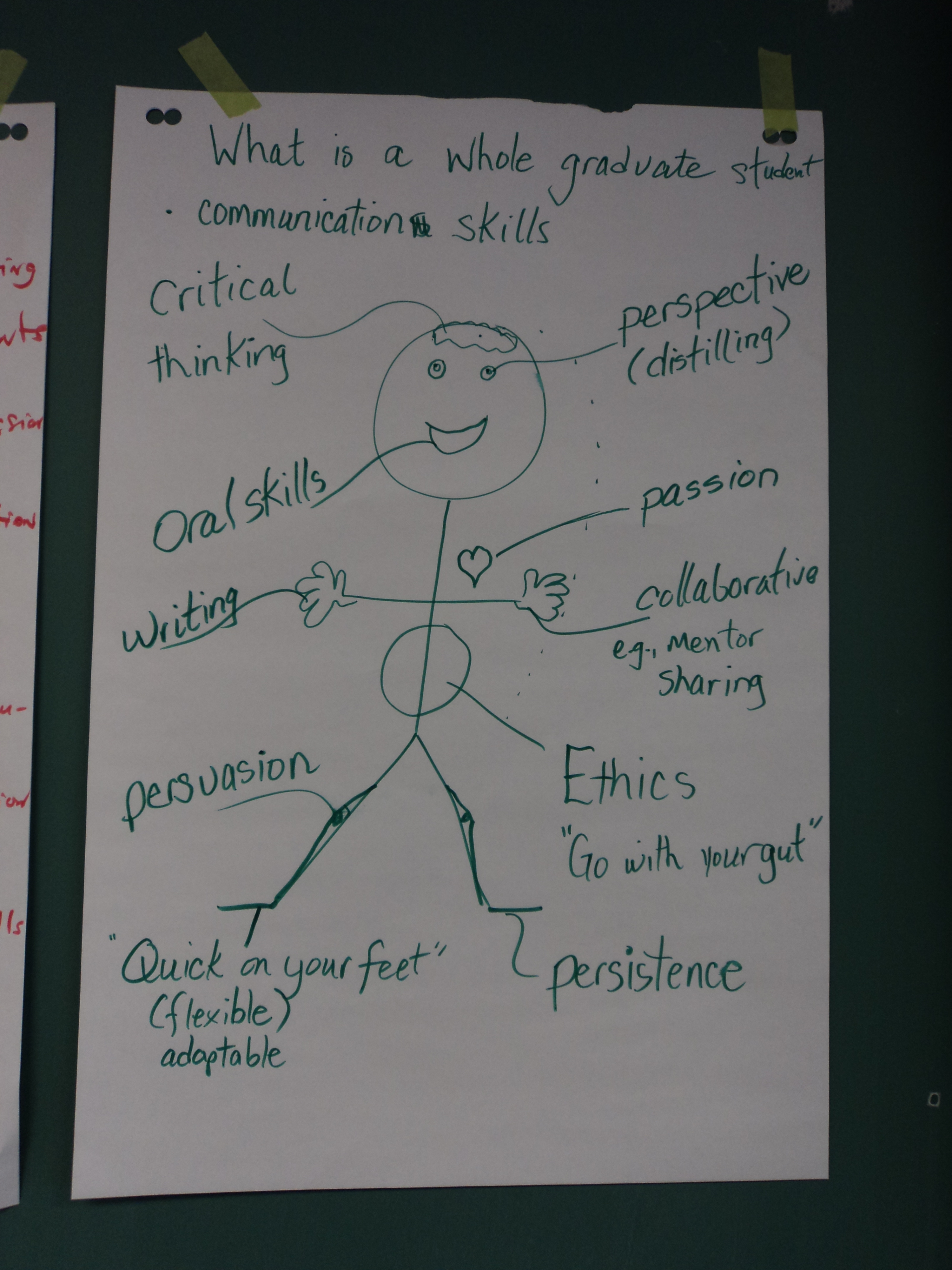
Finally, as I mentioned last week, I was just at a conference on graduate student development. It was a great opportunity to meet with graduate students, graduate administrators, and faculty to discuss ways to support graduate students. In addition to making a presentation on the role of thesis writing in the professional development of graduate students, I was also able to attend some great sessions about other aspects of graduate student development. At one such session, we were asked to define a ‘whole’ graduate student. It was an interesting question; we all know that a graduate student is more than just an intellect, but it was fun to try to identify all the components that make up a rounded and successful graduate student. One of the members of my group had the great idea to draw a figure and then identify the different tasks associated with different parts of the figure. I loved the idea of a fully embodied graduate student, one who has to draw on all of his or her resources—intellectual, emotional, and physical—in order to meet the multifaceted demands of graduate study. Here is the image we came up with:

Photo Credit: Sophia Kapchinsky

You can see a mind for critical thinking; eyes for greater perspective; a mouth for oral presentations; a heart for passionate commitment; one hand for writing and the other for collaborative work and mentoring; a gut for ethical instincts; feet for flexibility (being ‘quick on your feet’) and persistence (being ready to ‘go the distance’); and, my favourite, knees upon which to beg for funding. Thanks to all the members of our group! I wish I had learned all of their names so I could give them full credit here.

Links: Appreciating Feedback, PhD Reflections, Negative Results

Here is a great post from the Hook and Eye blog about the role of reviewers and editors in the writing process. I liked this post for two reasons. First, I appreciate the emphasis on the learning that can happen during the submission/rejection/revision/acceptance process. Throughout this process, there will be feedback on your writing; not all of it will be constructive and helpful, of course, but much of it will. Being open to learning from that feedback is crucial. Second, the post offers a valuable reminder that the writing we read—and desire to emulate—has been through so much polishing. Given how hard we all are on our own writing, we can’t have too many reminders about how much revision published work has been through.

Here is something from Inside Higher Ed on the singular moment of finishing a PhD: what is lost, what is gained, and what we should understand about ourselves as we prepare for the next step.

Finally, an old joke with a thought-provoking punch line from the Crooked Timber blog.

Links: Writing Anxiety, Explaining Your Project, Spot the Fake

From the University of Venus blog, here is a post on the relationship between writing anxiety and graduate school. This post made me reconsider the proper balance between the demands of a coherent discourse community, on the one hand, and the writer’s own need for creative expression, on the other. I generally argue that the former is a source of productive limits, of limits that push us to be explicitly aware of our audience while writing. I believe that some of the anxiety of writing can stem from a lack of limits: being able to say whatever we want can sometimes stop us from saying anything at all. My response to the writing anxiety of graduate students is often to encourage them to use those disciplinary limitations to their advantage. Assuming a place within an ongoing conversation can feel more manageable than having to create something entirely new. But perhaps I should be more aware of those students for whom this insistence on form suggests a closing of possibilities in their writing. Teaching an activity such as writing requires one to establish what is true for most writers and what may be true only for some. Do you find the notion of joining a discourse community comforting or claustrophobic?

Here is some advice from The Chronicle of Higher Education on academic writing. This list of ten ways to write ‘less badly’ is full of interesting ideas; I particularly liked the author’s suggestion that when we are deeply engaged with our writing we may actually be quite inarticulate about what we are doing. One of my standard pieces of advice is to have an easy capsule version of a thesis project (because I think life is better when you can easily answer the ‘what are you working on’ question). But I love the idea that our frequent inarticulacy can come as a result of being immersed in the moving waters of an ongoing and engaging project.

Finally, here is a post from Stuff Academics Like: Can you spot the fake article title? I actually appreciate outlandish article titles, so I didn’t view this as an exercise in mockery. I should probably add that I appreciate these titles personally; officially, I always sound an appropriate note of caution about fancy titles. Be particularly wary of puns: an experienced journal editor in your field has heard them all before.

Links: Language Sticklers

Last week, I posted a link to a brief discussion in The New Yorker about the inclusion of abbreviations (OMG), symbols (♥), and slang (muffin top) in the OED. I included it originally because I was amused at the predictable outrage.* But as I thought about it more, I began to feel that there was an important point to be made about usage and writing. Not only is the outrage based on a misunderstanding of the proper role of a dictionary, it also overlooks the importance of context for writing decisions. The dictionary doesn’t tell us what words are suitable in our writing; the inclusion of annoying usage in a dictionary has no real role to play in our usage decisions for formal writing. We have to decide what language is appropriate for our purposes and our audience, and our ability to make those decisions comes from having a sound grasp of the specific context in which we write.

This brief consideration of language outrage brings me to an post from the New York Times’ Schott’s Vocab blog by Robert Lane Greene. Drawing on his book You Are What You Speak, Greene discusses what language sticklers get wrong. I particularly liked his consideration of what he calls ‘declinism’: the view that language was better yesterday and will be worse tomorrow. His most interesting point concerns the role of mass literacy: “So a bigger proportion of Americans than ever before write sometimes, or even frequently, maybe daily…. A century ago, a nation of 310 million engaged with the written word on a daily basis was unthinkable. Now its uneven results are taken as proof by some that language skills are in decline. That is far from obvious.” Here is a review of Greene’s book, also from the New York Times. In this review, Geoffrey Nunberg provides an amusing summary of Greene’s critique of modern ‘declinism’: “We’ve passed from the thoughtful homilies of Fowler to the pithy dictums of Strunk and White to the operatic curmudgeonry of modern sticklers like Lynne Truss, whose gasps of horror at the sight of a misplaced apostrophe are a campy cover for self-congratulation.” I agree, and I love the irony of the sentiment: The written word may not be in decline, but the quality of the jeremiads is definitely slipping.

* I was also reminded about an article by Ben Yagoda that I discussed in an earlier post; Yagoda observes that student writers don’t generally use slang in their writing, preferring instead to use the vaguely elevated language that he calls ‘clunk’. The inclusion of slang in a reputable dictionary isn’t likely to cause an outcropping of informal academic writing. Novice writers may need help managing formality in their writing, but not because they are confused between their academic writing and their social media writing.

Links: Journal Article Publishing, Paywall at the Times, Additions to the OED

The blog PhD2Published recently ran a three-part series on journal article publishing: getting started; choosing a journal; and dealing with rejection. If you are thinking about publishing for the first time, it is a great idea to expose yourself to as many sources of information and opinion as you can; this blog has an extensive list of academic publishing resources. If you are working in the sciences, you may also be interested in this piece from Science on publishing in scientific journals.

This blog post from The Scholarly Kitchen discusses the new paywall at the New York Times. The author points out that the paywall allows the paper to charge organizations for access. While some individuals may get around  the paywall by accessing Times’ stories through social media or blog readers, institutions will pay for subscriptions, giving the Times the financial support it both needs and deserves.  

Lastly, here is something from The New Yorker Book Bench blog on the new additions to the OED. Ian Crouch has given an amusing account of the predictable outrage that attends any inclusion of novel coinage in an authoritative dictionary. In his words, the OED is a “far-reaching collection of English words, with an eye to history, which aims to be both prescriptive (these words and only these words are correct) and descriptive (these are the words that are used, as here’s how). When historians, linguists, and the generally curious want to know how people spoke in the twenty-first century, it will be useful to know about OMG and LOL, and how the phrases reflected usage that ranged from serious, to semi-serious, to full-on ironic.”

Links: Life of the Mind, Scientists in the News, In Defence of the Humanities PhD

From Inside Higher Ed, here is an essay about the implications of the shifting attitudes of universities to the study of humanities; according to Andrew Taggart, if our universities continue to move from a ‘welfare’ to a ‘neo-liberal’ view of education, humanities research will suffer. With this in mind, the author suggests some new models for thinking about the life of the mind outside a university setting.

Here are two interesting reflections on the role of scientists as interpreters of current events. Writing in the University of Venus blog, Itir Toksöz discusses the role of scientists as experts, arguing that their highest responsibility should be to present the general public with accurate scientific information. The Women in Wetlands blog discusses how the scientific approach to certainty can be misused to justify opposition to established scientific claims.

I have to admit, I was tired of these so-you-want-to-get-a-[degree] videos almost as soon as I saw my first one: the cynicism quotient is just too high for me. So I was interested to see one–Yes, I want to get a PhD in the Humanities–that tries to acknowledge some of the privilege and pleasure of graduate study in the humanities. I was subsequently even more interested in the virulence of the reaction to this video; commenters were very quick, I thought, to suggest that any expression of positivity in this realm was naive if not delusional. Finally, if you are curious about these videos, here is an article from The Chronicle of Higher Education about the broader phenomenon of Xtranormal videos.

Links: National Inquirer meets Scientific Research, Social Media and Academics, DIY Academic Sentence Generator

This article from Inside Higher Ed describes an attempt by the Association of American Universities (AAU) to defend scientific research from mockery and poorly informed funding cuts. Make sure you follow the link that the article provides to the Scientific Inquirer: it will take you to the inaugural issue of a faux tabloid that the AAU has created to show how easy it is to make valuable peer-reviewed research sound daft and wasteful.

Here is something from The Chronicle of Higher Education on social media use among academics. The author summarizes a new report from the Centre for Information Behaviour and the Evaluation of Research, a report which found that academics are using social media for “collaborative writing, conferencing, sharing images, and other research-related activities”. Interestingly, the researchers found that the biggest users of social media were scholars from the social sciences and humanities; they suggest that the appeal of social media for these scholars may be the increased speed of dissemination. The Scholarly Kitchen provides a nuanced and critical response to the study, focusing in particular on the fact that ‘social media’ has been defined so broadly in this study as to be potentially meaningless.

Finally, if you have some extra time on your hands this weekend, The University of Chicago Writing Program has a great game for you: Write Your Own Academic Sentence. Here is my first attempt: ‘The linguistic construction of the gaze invests itself in the historicization of agency.’ To get the full effect, you need to use the ‘Edit It’ option on your sentence. Once you are satisfied, you can even get a second opinion from a virtual critic: ‘Your desultory treatment of the linguistic construction of the gaze deserves the obscurity into which it has fallen.’ Hopefully, once you are done playing, you’ll be able to get back to writing sentences that don’t sound like this!

P.S. I mentioned the Day in the Life of the Digital Humanities project last week. If you are interested in seeing how this project is shaping up, you can follow blogs from all the participants here.

Links: Cascading Review, Digital Humanities, Research in Haiku

Here is a blog post from The Scholarly Kitchen that discusses some of the strengths and weaknesses of cascading peer review.  In cascading peer review, a journal will forward a rejected article (and its peer reviews) directly to another appropriate journal, thereby allowing the article to be considered by a new journal without the author having to repeat the submission process. This practice certainly isn’t standard but has been adopted by some larger publishers.

Friday, March 18 will be a Day in the Life of the Digital Humanities: “A Day in the Life of the Digital Humanities (Day of DH) is a community publication project that will bring together digital humanists from around the world to document what they do on one day, March 18th. The goal of the project is to create a web site that weaves together the journals of the participants into a picture that answers the question, ‘Just what do computing humanists really do?’ Participants will document their day through photographs and commentary in a blog-like journal. The collection of these journals with links, tags, and comments will make up the final work which will be published online.” Click here for an interesting collection of definitions of the digital humanities. I am planning to participate in this project, so I’ll discuss that experience in a future post.

Finally, here is a lovely blog devoted to dissertation research presented in the form of haiku. What makes this blog so enjoyable is that each contributor also provides a more conventional explanation of their research, allowing us to compare the poetry to the prose. I offer this link as more than just entertainment: I suggest trying it at home. Anything we can do to get at the essence of our research (even reconfiguring it as a 17-syllable poem) is likely to give us further insights into our own projects.

Links: Grammar Day, Fowler Revisited, Googlization

Happy National Grammar Day, everyone! Needless to say, it is always grammar day around here, but I am glad all of you get to join in the fun once a year. If you click the link, you’ll find grammar day e-cards, a theme song, a recipe for the grammartini, an exposé of common grammar myths, and even merchandise!

From The New Criterion, here is a review of Fowler’s A Dictionary of Modern English Usage: The Classic First Edition. In the review, Barton Swaim discusses a reprint of Fowler’s first edition as a way of revisiting the ongoing debate between descriptivism and prescriptivism. Swaim argues, in effect, that prescriptivism is both inevitable and way more fun. We will always, in his view, go looking for expert opinion about our writing decisions. And those expert opinions will be more stimulating than the bland descriptivist work of academic linguists. I have no trouble with the view that prescriptivism is more entertaining and often more immediately satisfying. However, what Swaim’s highly dismissive account of descriptivism fails to take into account is the possibility that persistent exposure to descriptivism might actually change the way we approach questions of usage. That is, a dominant descriptivist view might discourage our belief that all educated writers should use language in only one way and that all deviance from that way is deficiency. It may be unsatisfying to be told that a particular usage will be acceptable to some readers and unacceptable to others, but that may be all we, as writers, can hope for: a sound description of current practice to help us make up our own minds.

From Inside Higher Ed, here is a review of Siva Vaidhyanathan’s book The Googlization of Everything (And Why We Should Worry). The review includes an interview with Vaidhyanathan, who offers a clear-eyed case that Google’s ubiquity is significant. If everyone gets their information via Google, it matters how Google’s search standards are constructed. Despite its title, the book is clearly less a condemnation of Google, more a call for greater public conservancy of the wealth of human knowledge; Vaidhyanathan is urging us to have a serious discussion about the responsibilities and risks of the digital scholarship era.