
Author Archives: Rachael Cayley

Remembering to Edit

The hardest thing about editing may be that we often forget to do it. Not in an ‘oh no, I forgot to edit my paper and went to the mall instead’ way, but in an ‘oh no, I read the whole paper but stopped editing on the middle of page two’ way. Our own writing is notoriously difficult to edit. We are so familiar with our ideas and our choice of words, and familiarity often lulls us into an easy reading rhythm that isn’t sufficiently attuned to the editing task. However, if we have accepted that we must commit to extensive revision, we need ways to overcome these natural difficulties. Here are some editing strategies that help us to edit and not just read:

  1. Let time elapse.The most obvious technique will be to leave time before editing a draft. Your own work is the hardest to edit, of course, because you know what you are trying to say. Professional or peer editors can be guided to some extent by their own confusion. You have to devise ways of making sure that you are seeing the work from the perspective of someone unfamiliar with your project. Letting time elapse is the surest way of accomplishing this goal. When I discuss this strategy in class, students often appear highly sceptical, even amused. While they don’t usually say much, I imagine them to be thinking, ‘Sure, this sounds great and I know that I should be doing this, but I’m not and I never will, so what else you got?’. I do persevere with this pie-in-the-sky advice because it does actually become more realistic as graduate study progresses; during the thesis writing process, ‘letting time elapse’ is inevitable for even the most last-minute person. As you move ahead with later chapters, make sure you go back and work through earlier material with fresh eyes and without a looming deadline. But since we often do edit under time pressure, here are some other strategies that will work even when time is tight.
  2. Read your work aloud. Since your work will sound foreign to you as it is read aloud, this practice will help you to cultivate a different sort of awareness of your own writing.
  3. Read paragraphs out of order. This practice will help to prevent you from neglecting the writing itself in favour of focusing on the underlying ideas. Looking at paragraphs in isolation can also help focus your attention on paragraph cohesion.
  4. Stop at the end of each paragraph. By stopping at the end of each paragraph, you can confirm for yourself that you have actually edited that paragraph.
  5. Edit in stages. It is very difficult to edit with more than one problem in mind. Plan to edit your document a number of times, targeting specific issues each time. Choose a logical order, starting with the broadest issues and moving to finer issues.

Do you have other ways of concentrating your mind on the editing task? Feel free to share your successful editing strategies in the comments below.
Links: Communicating Research, Understanding Procrastination, Drawing Pictures

From Inside Higher Ed, here is something on explaining doctoral research in general terms. It is easy to see why the PR department of a university might be interested in having doctoral students or recent graduates who can comment cogently on their work for a general audience. But I think this ability can also be great for you as a writer. In the first place, being able to give a ready account of your work will boost your confidence; it never feels good to stumble over an explanation of the project to which you have devoted your whole life. And the clarity and simplicity that you achieve when you encapsulate your research will always help you to understand it better.

Also from Inside Higher Ed, here is something on procrastination. This article reviews a new book by Piers Steel, The Procrastination Equation: How to Stop Putting Things Off and Start Getting Stuff Done. I particularly liked how the article referred to Steel as a ‘procrastination expert’; I am pretty sure we all think of ourselves as procrastination experts! The point that jumped out at me in the interview with Steel was his comment on procrastination among people who are ABD: “Doing any major task for the first time is extremely hard motivationally as you don’t have a firm mental image of what you are supposed to be doing.” It’s a simple point, but still a profound one. Not being able to see the full trajectory of the project can leave us uncertain and thus prone to procrastination.

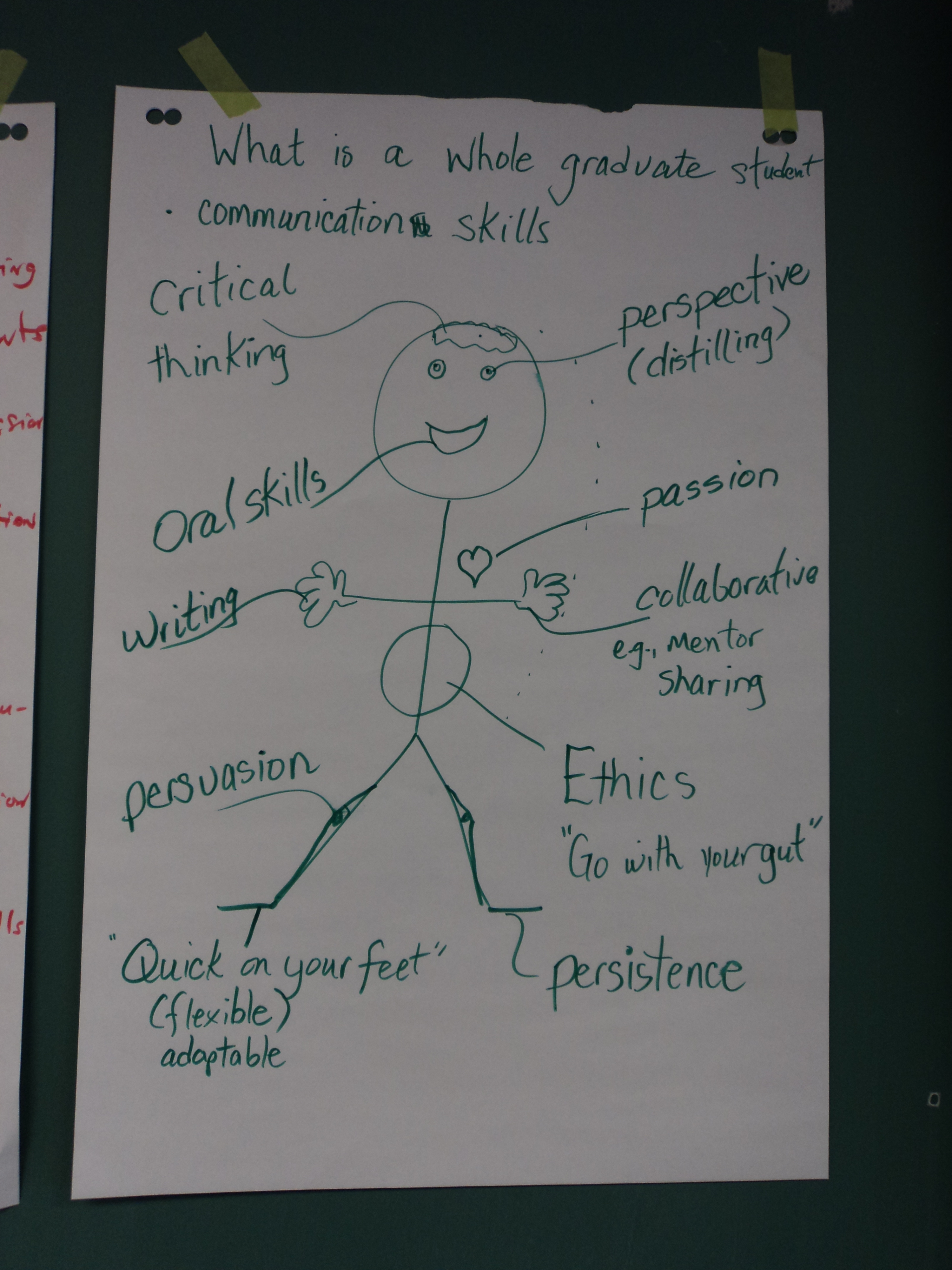
Finally, as I mentioned last week, I was just at a conference on graduate student development. It was a great opportunity to meet with graduate students, graduate administrators, and faculty to discuss ways to support graduate students. In addition to making a presentation on the role of thesis writing in the professional development of graduate students, I was also able to attend some great sessions about other aspects of graduate student development. At one such session, we were asked to define a ‘whole’ graduate student. It was an interesting question; we all know that a graduate student is more than just an intellect, but it was fun to try to identify all the components that make up a rounded and successful graduate student. One of the members of my group had the great idea to draw a figure and then identify the different tasks associated with different parts of the figure. I loved the idea of a fully embodied graduate student, one who has to draw on all of his or her resources—intellectual, emotional, and physical—in order to meet the multifaceted demands of graduate study. Here is the image we came up with:

Photo Credit: Sophia Kapchinsky

You can see a mind for critical thinking; eyes for greater perspective; a mouth for oral presentations; a heart for passionate commitment; one hand for writing and the other for collaborative work and mentoring; a gut for ethical instincts; feet for flexibility (being ‘quick on your feet’) and persistence (being ready to ‘go the distance’); and, my favourite, knees upon which to beg for funding. Thanks to all the members of our group! I wish I had learned all of their names so I could give them full credit here.

Colons

Today I am going to talk about colons. Before we look at the stylistic advantages of using colons, let’s look at the rules of colon use. In fact, let’s look at the only rule of colon use: a colon should appear after a complete sentence. In other words, don’t put a colon in the middle of a sentence:

This paper will consider: strategy, structure, personnel, and process.

The writer has presumably used a colon here because what follows is a list. But the decision about colon use actually needs to be made on the basis of what precedes the colon. This example is no different, logically, than the following: ‘I went to the store to buy: milk and eggs.’ In both cases, the colon is redundant because the items being listed are part of the sentence. Now consider a slight modification:

This paper will consider four areas of inquiry: strategy, structure, personnel, and process.

In this case, we have a complete sentence before the colon. If we want to go on to say what those four areas of inquiry are, we need to provide that information separately. A colon allows us to indicate that what follows will provide the information necessary to complete the thought found in the first sentence. Note that what follows a colon need not be a full sentence; single words, phrases, and full sentences can all appear after a colon.

With one simple rule—a colon should appear after a complete sentence—we are ready to see the stylistic advantages of the colon. Here are the three possible versions of our example:

This paper will consider: strategy, structure, personnel, and process.

This paper will consider four areas of inquiry: strategy, structure, personnel, and process.

This paper will consider strategy, structure, personnel, and process.

The final version seems to me to be the best. The first version, as we have seen, is incorrect, and the second version, while perfectly acceptable, seems a bit ponderous. In a sentence this simple, there is no need for a full sentence to introduce a list. (I might change my assessment of the second version if these ‘four areas of inquiry’ had ongoing structural significance for the paper; in that case, identifying them as such might be valuable.) If you find yourself putting a redundant colon in the midst of a simple list, you can just take it out and carry on. If, however, you find such a colon in a more complex sentence, it may be trying to tell you something. Consider this example:

This paper will consider: the nature of strategy in the high-tech industry in the period starting in 1983, the structure, both financial and organizational, of CHX Corporation, the management of personnel in this company at this time, and the process whereby the company came to occupy such a dominant market position.

In this case, the colon—while still technically redundant—is definitely there for a reason. The author used a colon in response to an inkling that the reader would need to know that a list is coming. So, in this case, try keeping the colon and adding the requisite words to create a full sentence before that colon.

This paper will consider four areas of inquiry: the nature of strategy in the high-tech industry in the period starting in 1983; the structure, both financial and organizational, of CHX Corporation; the management of personnel in this company at this time; and the process whereby the company came to occupy such a dominant market position.

(You will see that I have also added semicolons in the place of commas between the list items; I have done so because one of the list items had internal commas, which will potentially inhibit the readers’ ability to understand the list. I will address this issue in more detail in a future post on writing effective lists.)

I will end by commenting on the way that colons can be an efficient and elegant way to convey the relationship that exists between parts of your writing. Here is a sentence that I used at the outset of this post:

 In fact, let’s look at the only rule of colon use: a colon should appear after a complete sentence.

Here a colon allows us to fulfill the promise of the first sentence without belabouring the point. We don’t have to say ‘In fact, let’s look at the only rule of colon use, which is that a colon should appear only after a complete sentence.’ The version with the colon is, in my view, preferable since it uses fewer words and avoids a commonplace pattern of subordination.

If you have questions about colons or thoughts about the role they play in academic writing, please leave them in the comments below.

Using Resources for Thesis Writing

As a graduate writing instructor, I think about thesis writing much of the time. And this week I am thinking about the topic even more than usual. I am starting a new thesis writing course this afternoon, and I am making a presentation at a conference on Friday on thesis writing as professional development. Since thesis writing is all that I’ll be thinking about anyway, I thought I would devote today’s post to the idea of using resources for thesis writing.

In my presentation on Friday, I am going to discuss how a thesis writing course can be a valuable form of professional development for graduate students. Simply put, writing instruction becomes professional development when it focuses on the writer rather than on a particular piece of writing. As long as thesis writers see their goal as merely surviving the ordeal of writing a thesis, they are not likely thinking about their long-term development as academic writers. My presentation will focus on two ways that thesis instruction can encourage this sort of professional development. First, a thesis course can present the notion of thesis as genre, an approach which opens students’ minds to a new dimension to their responsibilities as writers; not only are they trying to complete a particular research task, they are also trying to convey that research in a form that is meaningful and valuable to the research community they seek to join. Second, a thesis course can also discuss the resources necessary for a student to thrive during the thesis writing process. It is this second aspect that I wish to touch on here today.

When I speak about resources in the thesis course, I am doing so in order to make students aware that there are so many resources available and that they can significantly improve their own writing process by availing themselves of such resources. Too often, I encounter students whose ‘writing resource’ is their supervisor; in some cases, of course, this works well, but more often it leaves the student feeling under-supported. Thesis writers generally need to move from thinking of themselves as fully dependent on a supervisor to thinking of themselves as developing academic writers who can take advantage of a range of resources. The sort of resources I have in mind include books on thesis writing; completed theses, especially if they are linked by a shared supervisor or by similar topics, methodology, etc.; thesis writing groups; courses on thesis writing or on academic writing more generally; published work in the student’s own field; and blogs about the thesis writing process. 

Such resources are plentiful (and multiplying rapidly), so I’ll mention just one today. I particularly want to recommend The Thesis Whisperer. This site presents wide-ranging advice that is both accessible and wise. Broad topics include the writing process; working with a supervisor; the oral presentation component of thesis completion; using new technologies in the writing process; productivity and other psychological aspects of the writing process; publishing considerations; and general research support. Anyone writing a thesis will find some parts of this advice, with its warm and supportive tone, helpful and relevant. It is impossible, of course, for any source of support to be universally applicable; a necessary part of using a broad range of resources is developing the ability to distinguish between advice that is appropriate for your circumstance and advice that would be better suited for someone else (for instance, someone working in a different country or someone from a different discipline or someone with a different theoretical framework). That is, even the most general advice is inevitably rooted in a particular context, and we all must learn to ‘read’ advice and support in such a way that its value for us becomes apparent.

Taking advantage of an expanding range of resources is a way of improving the thesis writing process. Although we all know that we are not actually the first person ever to write a thesis, many of us instinctively approach our writing life as though we were. Figuring it out as we go along; hoping for the best; using trial and error to make key decision; treating a supervisor as the only source of support and feedback—all of these strategies tend to isolate us and keep us unnecessarily apart from the community of thesis writers. If you are writing a thesis, take stock of your current situation so that you can find the resources that will ultimately improve your life as a writer.

Links: Appreciating Feedback, PhD Reflections, Negative Results

Here is a great post from the Hook and Eye blog about the role of reviewers and editors in the writing process. I liked this post for two reasons. First, I appreciate the emphasis on the learning that can happen during the submission/rejection/revision/acceptance process. Throughout this process, there will be feedback on your writing; not all of it will be constructive and helpful, of course, but much of it will. Being open to learning from that feedback is crucial. Second, the post offers a valuable reminder that the writing we read—and desire to emulate—has been through so much polishing. Given how hard we all are on our own writing, we can’t have too many reminders about how much revision published work has been through.

Here is something from Inside Higher Ed on the singular moment of finishing a PhD: what is lost, what is gained, and what we should understand about ourselves as we prepare for the next step.

Finally, an old joke with a thought-provoking punch line from the Crooked Timber blog.

Problem Sentences

Sentences come in many varieties: there are elegant sentences, workhorse sentences, clever sentences, short sentences, and long sentences. There are also problem sentences. You know the ones: you keep coming back to them and making changes without every being satisfied. In fact, after a while, you start to suspect that your newest changes are simply reinstating earlier versions of the sentence. This back-and-forth alone is significant; if you are alternating between two versions of a sentence without ever being happy with either, you need to do something dramatic. This need is intensified by the fact that these problem sentences are generally important sentences. I am generalizing, of course, but I am doing so with lots of evidence. The sentences that we use to convey key points are more likely to give us trouble, both because our investment in the topic can cloud our thinking and because our key points generally involve a complex array of information.

When you are confronted with such a sentence, my suggestion is to try what I call ‘blank-side-of-the-page writing’. Since sentences have this way of wearing a groove in our brains, we need strategies to help us get a fresh start. In one-on-one writing consultations, I often ask students to tell me what a challenging sentence is about. What they say is generally much stronger that what they have written. And stronger in two ways: more direct and less brief. You can see why direct is better, but you may be wondering why I am praising a lack of brevity. Indeed, most of us are less concise in writing than we ought to be, until we try to convey our key point; then, many of us become positively telegraphic. Forcing ourselves to devote more ink to our own ideas is a sure way to improve academic writing.

If you write down—on the blank side of the page—exactly what you come up with when you try to convey the key point to an imaginary interlocutor, you will have something new with which to work. Even if all you do is disrupt the pattern of futile revision, you will be ahead of where you were. But you may find that you do considerably more than that by forcing yourself to rearticulate a key point. Certainly, by inserting a potential reader into the process, you are immediately improving your chances of structuring your ideas in a way that will suit that reader.

It is hard to show an example of this technique since it requires an actual conversation (either between writer and writing instructor or between writer and herself/himself). But try it yourself and see whether it helps you. Here is how the process might work:

  1. Identify a sentence that has been giving you trouble. 
  2. Read it over, identifying its key ideas and thinking about the relationship between its parts.
  3. Turn over the page, so you can no longer see the original sentence.
  4. Imagine someone asking you what you were trying to say in the original sentence.
  5. Answer that question aloud and try to write down verbatim what you come up with. At this stage, be fulsome: take advantage of the fact that we tend to articulate things more fully in spoken language.
  6. Assess what you have come up with, remaining open to all possibilities (Should it be more than one sentence? Is it undermined by missing information? Does it appear at the correct point in the text?).
  7. Finally, edit it to be sure that it hasn’t retained any of the informal tone you many have introduced by transcribing a spoken version.

This strategy can help you get past an impasse with a particular sentence and can help you to push yourself to articulate your key ideas with more clarity and precision.

Interrupting Yourself

One of the challenging things about this blog is the process of dividing the broad topic of academic writing into manageable bits. My goal is to have posts that are short, self-sufficient, suitably comprehensive, and recognizably part of a broader whole. Since that broader whole, by definition, doesn’t exist yet, I am struggling to find the optimal way to divide things up. I recently wrote a post on dashes, which I thought would be a neat and tidy little topic. As it turned out, I actually had quite a bit to say about dashes. In the end, I ran out of space before I had dealt with the implications of interrupted sentences in academic writing (thanks to my husband for diplomatically pointing this out). So here is another attempt to discuss this issue, focussing particularly on how to decide what punctuation to use when interrupting yourself. Let’s start with that basic idea: interruption. When and how should you interrupt yourself? As I said in the earlier post, interruption is a stylistic aberration and thus not something to be overused. But there are times when we need to add extra information into our sentences. Consider the following three examples:

Civil society (a concept that is notoriously difficult to define) is crucial to any attempt to increase voter turnout in a proportional representation electoral system.

Civil society, a concept that is notoriously difficult to define, is crucial to any attempt to increase voter turnout in a proportional representation electoral system.

Civil society—a concept that is notoriously difficult to define—is crucial to any attempt to increase voter turnout in a proportional representation electoral system.

Which of these do you prefer? Chances are you prefer the second one; barring some special circumstance of which we are unaware, this particular interruption is best managed with commas. To review, commas are the least obtrusive way of interrupting yourself; parentheses announce that something is unimportant and not worthy of integration into the sentence; and dashes draw the reader’s attention to the material. In this case, the interruption should likely be handled with commas because the point needs to be made but not emphasized.

Here are some examples of sentences with unimportant interruptions (e.g., technical information, dates, terminological clarifications):

The sensor (LK-G82, KEYENCE company) is put inside a casing and then used to measure impact velocities.

Isaac Newton (1643–1727) wrote extensively on Biblical hermeneutics.

Funding was provided to elementary schools (kindergarten through grade eight) and secondary schools (grades nine through twelve).

In each of these cases, parentheses seem like the best choice; in fact, using commas in their place would require us to use extra words and would draw unnecessary attention to useful but uninteresting information.

Here, however, are some borderline instances of parentheses usage:

Individuals with unusable surveys (due to either illegibility or incompleteness) will not be included in the second level of analysis.

Earthenware vessels (among other artefacts) were present in the region.

Of these barriers to cycling, the most likely candidates include weather elements (such as rain or snow) and safety elements (such as bike lanes and bike-friendly intersections).

I would likely recommend not using parentheses in these sorts of cases. My guiding principle is that the author should have a sound reason to exclude the bracketed information from the sentence proper. In each of these three cases, I think the parentheses could be avoided by using commas.

Now let’s turn briefly back to dashes. As we saw in the earlier post, dashes indicate that something is worthy of extra attention:

The issues that confront students entering late-stream French immersion programs—most importantly, their lack of familiarity with instructional vocabularies—are a pressing concern for school administrators.

We also learned that dashes can help us when using commas would make the sentence needlessly complex. In such a case, we may decide to use dashes to interrupt ourselves even though the intervening material isn’t especially noteworthy. Consider these two examples:

Since architects are dependent on domain knowledge, generally elicited from specialists, users, and stakeholders, the development of guidelines should not be dependent on general algorithms.

Since architects are dependent on domain knowledge—generally elicited from specialists, users, and stakeholders—the development of guidelines should not be dependent on general algorithms.

The second sentence is, in my view, easier to read. However, the dashes are there for clarity rather than for emphasis, and one could quibble that I have overemphasized the interruption. It is important to find a balance; in some cases, I would definitely reword rather than use dashes to solve this type of problem.

I think I am now finished with dashes and the related question of sentence interruptions. But if you have further questions associated with this issue, please raise them in the comments below. Next we will look at an editing strategy designed to help us deal with our problem sentences.

Links: Writing Anxiety, Explaining Your Project, Spot the Fake

From the University of Venus blog, here is a post on the relationship between writing anxiety and graduate school. This post made me reconsider the proper balance between the demands of a coherent discourse community, on the one hand, and the writer’s own need for creative expression, on the other. I generally argue that the former is a source of productive limits, of limits that push us to be explicitly aware of our audience while writing. I believe that some of the anxiety of writing can stem from a lack of limits: being able to say whatever we want can sometimes stop us from saying anything at all. My response to the writing anxiety of graduate students is often to encourage them to use those disciplinary limitations to their advantage. Assuming a place within an ongoing conversation can feel more manageable than having to create something entirely new. But perhaps I should be more aware of those students for whom this insistence on form suggests a closing of possibilities in their writing. Teaching an activity such as writing requires one to establish what is true for most writers and what may be true only for some. Do you find the notion of joining a discourse community comforting or claustrophobic?

Here is some advice from The Chronicle of Higher Education on academic writing. This list of ten ways to write ‘less badly’ is full of interesting ideas; I particularly liked the author’s suggestion that when we are deeply engaged with our writing we may actually be quite inarticulate about what we are doing. One of my standard pieces of advice is to have an easy capsule version of a thesis project (because I think life is better when you can easily answer the ‘what are you working on’ question). But I love the idea that our frequent inarticulacy can come as a result of being immersed in the moving waters of an ongoing and engaging project.

Finally, here is a post from Stuff Academics Like: Can you spot the fake article title? I actually appreciate outlandish article titles, so I didn’t view this as an exercise in mockery. I should probably add that I appreciate these titles personally; officially, I always sound an appropriate note of caution about fancy titles. Be particularly wary of puns: an experienced journal editor in your field has heard them all before.

Identifying Yourself as a Writer

Do you think of yourself as a writer? Graduate students write a great deal but rarely think of themselves as writers. Maybe this is analogous to how we think of other activities; I love to bake, for instance, but would never describe myself as a baker. A baker is someone who has training as such or who, at the very least, is paid to do so. Since neither of those is true for me, I am just someone who spends way too much time baking. Similarly, since we aren’t generally trained as writers or paid to write, we don’t call ourselves writers. But there are implications of being a writer–that is, someone who has to write frequently in order to meet key professional goals–who nonetheless shies away from that label. What would you say if asked to finish the following sentences?

‘As a writer, I am…’  

‘As a writer, I wish to be…’

Many of us will come up with sentences like these:

‘As a writer, I am not very good (or skilled or competent or efficient or happy or effective or confident).’

‘As a writer, I wish to be finished, so I don’t have to write any more!’

In my experience, people rarely think of themselves as writers, but they frequently think of themselves as bad writers. Adopting that sort of critical stance towards our own writing could be beneficial if it was part of a broader project of developing our writing skills. But novice writers often treat bad writer as an ontological category, as a condition that will afflict them forever and always. Needless to say, it can be hard to improve your writing if you are more or less resigned to never improving. If you are inclined to think of yourself as a bad writer, try lopping off the ‘bad’. Doing so may leave you with a more hopeful construction: ‘I am a writer who needs to improve in such-and-such ways. These improvements will come from such-and-such strategies.’

I recently came across an interesting article that discusses a range of strategies designed to improve the writing process:

[W]e have identified strategies that can help novices understand more about academic writing and their relationship with writing. One strategy is to confront and talk about rather than ignore the difficult emotions that writing stirs up. This can result in two potentially enabling insights for beginning academic writers. They learn that their feelings are not extraordinary but commonplace, and therefore not something to be anxious about. And by finding that their feelings are shared by more experienced writers, novices learn that difficult emotions need not get in the way of writing, can be managed rather than erased and might even be productive in the writing process. The second strategy is to explicitly address procedural know-how and expose what goes on in the writing process. This provides novices with information about strategies for productive writing, and assures them that what they currently perceive as failings (such as having to write and rewrite multiple times) are the very means for producing good writing. Novices learn that they are not deficient or lacking in skills but doing exactly what experienced writers do. Related to this, the third strategy is to…hail novices as academic writers—to use social settings, such as writing workshops, where novices, in the presence of others, take on tasks as if they were already experienced writers (for example, to read the work of an admired author not as a student seeking wisdom, but as a one writer inquiring into how another writer writes) (Cameron, Nairn, and Higgins, 2009; emphasis mine).

These strategies are expressed as ways that instructors can help students, and they are indeed all strategies that I find useful in my teaching. But they are also approaches that you can use yourself: you can talk honestly with your peers about your writing difficulties; you can accept that writing doesn’t come automatically and seek out the support that you need; and you can consciously adopt the role of academic writer as you approach the texts that you read. Even if writing support is hard to find, I urge you to continue to look for resources to help you implement these strategies in your own writing life. The blogroll is full of excellent resources, and I will return to these issues in future blog posts. For today, I will close with a post from the Hook & Eye blog that offers one writer’s reflections on the role of identification and acceptance in the writing process.

Source: Cameron, J., Nairn, K., & Higgins, J. (2009). Demystifying academic writing: Reflections on emotions, know-how and academic identity. Journal of Geography in Higher Education 33 (2), 269-284.

Links: Language Sticklers

Last week, I posted a link to a brief discussion in The New Yorker about the inclusion of abbreviations (OMG), symbols (♥), and slang (muffin top) in the OED. I included it originally because I was amused at the predictable outrage.* But as I thought about it more, I began to feel that there was an important point to be made about usage and writing. Not only is the outrage based on a misunderstanding of the proper role of a dictionary, it also overlooks the importance of context for writing decisions. The dictionary doesn’t tell us what words are suitable in our writing; the inclusion of annoying usage in a dictionary has no real role to play in our usage decisions for formal writing. We have to decide what language is appropriate for our purposes and our audience, and our ability to make those decisions comes from having a sound grasp of the specific context in which we write.

This brief consideration of language outrage brings me to an post from the New York Times’ Schott’s Vocab blog by Robert Lane Greene. Drawing on his book You Are What You Speak, Greene discusses what language sticklers get wrong. I particularly liked his consideration of what he calls ‘declinism’: the view that language was better yesterday and will be worse tomorrow. His most interesting point concerns the role of mass literacy: “So a bigger proportion of Americans than ever before write sometimes, or even frequently, maybe daily…. A century ago, a nation of 310 million engaged with the written word on a daily basis was unthinkable. Now its uneven results are taken as proof by some that language skills are in decline. That is far from obvious.” Here is a review of Greene’s book, also from the New York Times. In this review, Geoffrey Nunberg provides an amusing summary of Greene’s critique of modern ‘declinism’: “We’ve passed from the thoughtful homilies of Fowler to the pithy dictums of Strunk and White to the operatic curmudgeonry of modern sticklers like Lynne Truss, whose gasps of horror at the sight of a misplaced apostrophe are a campy cover for self-congratulation.” I agree, and I love the irony of the sentiment: The written word may not be in decline, but the quality of the jeremiads is definitely slipping.

* I was also reminded about an article by Ben Yagoda that I discussed in an earlier post; Yagoda observes that student writers don’t generally use slang in their writing, preferring instead to use the vaguely elevated language that he calls ‘clunk’. The inclusion of slang in a reputable dictionary isn’t likely to cause an outcropping of informal academic writing. Novice writers may need help managing formality in their writing, but not because they are confused between their academic writing and their social media writing.