
Tag Archives: Academic writing

Lists: Backwards and Forwards

The last post was about writing effective lists. In that post, I talked about two important aspects of lists. At the simplest level, we should be able to use parallelism to make sure our lists are easy to read. At a more sophisticated level, we should be able to look at our own lists analytically to see if we can deepen our understanding of the ideas we are trying to convey. Apparently, I have a lot to say about lists since I now realize that I have two more points I wish to make. Today I would like to discuss the first of those points: how to improve ‘backwards’ lists. These are lists that list first and explain themselves last. Here is an example:

Effective patient care, respect for patient and family knowledge about the condition, and the need for community support were all issues identified by the focus group.

As a reader, you aren’t aware that you are reading a list of issues until you get close to the end. At that point, you might have to double back to fully grasp the sentence. Or you might even have had trouble the first time through since the structure of the sentence isn’t self-evident. Here is a revision:

The focus group identified three issues: effective patient care, respect for patient and family knowledge about the condition, and the need for community support.

This simple revision—and certainly more could be done to improve this sentence—has two obvious benefits. One, it starts with a clear subject and a strong verb (‘The focus group identified’), and, two, it notifies the reader that a list is coming. It is valuable to have a strategy for dealing with backwards lists because they are a natural reflection of how we think; we often figure out what the ‘issues’ themselves are before we know to characterize them as issues. It seems plausible to me that we will write ‘x, y, and z all matter in some way’ before we can write ‘the significant issues are x, y, and z’.  We just need to remember to switch these backwards lists around; once they have done their initial work in allowing us to understand the list we are trying to construct, we can rework them in a way that suits the needs of the reader.

This strategy is also helpful in dealing with transitions between sentences. If you find yourself using a lot of additive transition words (for instance, ‘also’, ‘in addition’, ‘moreover’), it may be helpful to go back and see how the various points relate to one another. When we analyze the internal relationships in our writing, we will find many different sorts of relationships, most of which will benefit from being made more explicit. One of those relationships could be that of a list. Since I don’t have room here for an elaborate example, let’s look at a version of the sentence we used last week:

Today’s educational leaders must provide instructional leadership. In addition, they must demonstrate moral leadership and support their staff. Long hours on the part of educators are necessary to improve student achievement. Also, they must exercise fiscal prudence.

A quick analysis of this passage would show the writer that these four sentences all concern things an educational leader must do. It would then be easy to reword to reflect that commonality:

Today’s educational leaders have multiple responsibilities: providing instructional leadership, demonstrating moral leadership, exercising fiscal prudence, supporting their staff, and working long hours to improve student achievement.

While this example was simple (and slightly exaggerated for effect), it does show how implicit lists can be identified in our writing after the fact. Once we have so identified them, we can turn them into explicit lists. And an explicit list is, of course, a list that the reader experiences ‘forwards’: first the announcement of the list and then the list items themselves.

The final point I want to make about lists—how we can use them to guide the reader through our text—is too long to tackle in this post. So come back next time when I’ll talk about how the internal organization of a list communicates structural information to the reader.

Links: Rules for Writing, Strategies for Scientific Writing, Excuses for Plagiarism

Here is something from the Huffington Post on the difficulty of finding workable ‘rules’ for good writing. Robert Lane Greene provides a useful breakdown of types of rules for writing: rules that everyone knows; standard but tricky rules; obsolescent rules; disputed rules; non-rules; formality differences; regional differences; dialect differences; house style; and personal taste.  His use of these ten different categories shows how difficult it is to rely on simple notions of right and wrong in our writing.

Here is something from Inside Higher Ed on writing for science graduate students. In this piece, Stephen C. Stearns, a senior scientist at Yale, offers his own take on proposal writing, thesis writing, and publishing.

Finally, here is something amusing from The Monkey Cage blog: a top ten list of excuses for inexcusable plagiarism. If you missed the reference to Clippy, count your blessings.

Writing Effective Lists

At this time of year, I spend a lot of time meeting with students. In the next few blog posts, I plan to address some of the issues that come up over and over again in these sessions. I will start by talking about lists. I did discuss lists briefly in an earlier post on colons, but now I can treat the topic more fully. At the most basic level, lists are important because academic writing is full of them. But they aren’t just prevalent, they are also significant because they are used to convey both content and structural information. Here is an example to consider:

Today’s educational leaders face increasing demands for public accountability, working long hours to improve student achievement, providing instructional leadership, demonstrating moral leadership, exercising fiscal prudence, supporting their staff, and need to navigate a litigious environment while facing low teacher morale.

The first step is to identify the shared root of the list, the part that must work with each list item. In this case, the shared part of the sentence is ‘Today’s educational leaders face …’.

Today’s educational leaders face (1) increasing demands for public accountability, (2) working long hours to improve student achievement, (3) providing instructional leadership, (4) demonstrating moral leadership, (5) exercising fiscal prudence, (6) supporting their staff, and (7) need to navigate a litigious environment while facing low teacher morale.

The first thing we see is that educational leaders face increasing demands. So far, so good. But do they also face working, providing, demonstrating, exercising, and supporting? Probably not. There is nothing grammatically incorrect about those formulations, but they are awkward and presumably not exactly what the author intended. The final item is, in fact, grammatically incorrect. We cannot say ‘Today’s educational leaders face need to …’. And changing the final phrase from ‘need to navigate’ to ‘navigating’ would give us parallelism but would not solve the broader problem with the list.

The simplest solution will come from looking at the list items to see what they all have in common; we can readily see that each list item is something that educational leaders must do. By choosing a more general verb for the shared part of the list, we will then be able to accommodate a wider assortment of terms in our list. Here is a new version of our sentence:

Today’s educational leaders must  face increasing demands for public accountability, work long hours to improve student achievement, provide instructional leadership, demonstrate moral leadership, exercise fiscal prudence, support their staff, and navigate a litigious environment while facing low teacher morale.

This sentence is fine, but there may be more we can do. When analyzing list items, we need to consider that establishing parallelism may not be enough; we also need to consider that the ideas themselves may not actually be parallel. In this sentence, I would be inclined to separate out the things that educational leaders must do from the things that make those tasks even more challenging. We might say something like this:

Today’s educational leaders must provide instructional leadership, demonstrate moral leadership, exercise fiscal prudence, support their staff, and work long hours to improve student achievement. These responsibilities are further complicated by low teacher morale, a litigious environment, and increasing demands for public accountability.

By breaking up a list and grouping similar items together, we can often get more clarity about what we are trying to say. During the drafting process, it is easy to create lists out of what are actually dissimilar items; during the revision process, we can take another look and reorganize the list according to an enhanced understanding of our own communicative aims. (Note that in these two lists, I have placed the most complex list item last; lists are easier to read when the most grammatically complex items are put at the end of the list.)

A second issue with lists–one which we will have to look at in the next post–is the purpose of the list within a text. The example that we have been looking at today provides a bunch of information quickly. The sentence sounds as though the author simply needed to provide some necessary background without wanting to engage in any further discussion of these points. After reading this sentence, my expectation would be that these particular points would not be important in the rest of the text. Next week we will look at the way we use lists to accomplish a very different task: to anticipate and announce the structure of our texts.

Links: Why We Write, Peer Editing, Names and Titles

In this Academic Minute podcast, Dana Washington of Lock Haven University discusses why we write. She is speaking about writing broadly as self-expression, but I think her remarks also have relevance for academic writers. Admittedly, academic writers do write to fulfill various requirements and obligations, and we often do so under complicated pressures of both time and expectations. Despite these hindrances, however, we can still try to view the writing task as a valuable opportunity to share the research and reflections that inform our intellectual lives.

This article from the National Post has very little to do with academic writing, but I loved this quote  from Iain Reid about sharing our draft writing: “I rarely ask friends to read a work in progress. It’s a frustrating affair. My friends are busy. They have other things to read, interesting and funny things, things online or things that already have a title, spine and are bound; not disorganized sentences that are only partially formed. On the rare occasion it does happen, the results are frustrating, too. I don’t actually want to discuss it. I’m not actually hoping for constructive criticism. Just ignore the spelling mistakes, discount the preachy and rambly parts and just tell me how it’s borderline genius.” That basic asymmetry–I give you my writing asking for criticism but hoping for praise–presumably derails a lot of potentially valuable peer editing.

Finally, here is some practical advice from Inside Higher Ed on the use of titles when addressing faculty. And here is a related blog post from Hook and Eye by an instructor who will answer to anything. I too will answer to anything, but my preference is definitely for students to call me by my first name. The formality of titles may have value in some settings, but I feel it adds nothing to my teaching situation. In fact, the relative informality of using first names emphasizes, I hope, the way academic writing is an ongoing challenge that my students and I need to tackle together.

Blogging as an Academic Activity

In my last post, I mentioned that I was taking a week off from this blog to attend a conference at which I would be making a presentation about this blog. Since I have been so preoccupied with thinking about blogging, I thought I would devote today’s post to a consideration of how blogging relates to other academic activities.

Five months into this blogging adventure, I realize that it is premature to draw any definitive conclusions. But having to make a presentation on this topic forced me to come up with some provisional conclusions about the difference between blogging and other academic pursuits. Here are four themes that seem to characterize the singularity of the blogging experience:

  1. The blog allows me to craft my ideas into a form that endures outside of a particular class setting (blogging as permanent).
  2. The blog allows me to reach a broad number of people with whom I might otherwise have no connection (blogging as public).
  3. The blog allows me to share my thoughts in short bits at frequent intervals (blogging as periodic).
  4. The blog allows me to express my ideas in whatever way I choose without going through anyone else’s editorial process (blogging as personal).

Looking at these four themes together, I think it is possible to think of academic blogging as the creation of a hybrid space that combines aspects of traditional publishing (because it is permanent and public) and aspects of teaching (because it is periodic and personal). This hybrid space seems to be well suited to meeting the needs of graduate students who want to improve their academic writing skills: because it is public, a blog can be accessed whenever readers need it; because it is periodic, a blog can provide readers with information in manageable bits; because it is permanent, a blog can give readers the opportunity to pursue an issue further through earlier posts on related topics; and, finally, because it is personal, a blog can adopt a clear authorial stance that allows readers to determine whether it suits their writing needs.

The conference itself was great. Thanks to all CASDW members for an interesting and congenial weekend in Fredericton!

Links: Supporting Scientific Innovation, Libraries and Abundance, Writing to Your Dissertation

Explorations of Style will be taking next week off; I have to travel for a conference and, first, to make that travel worthwhile, have to write the paper I will be presenting at the conference. The presentation is on the role this blog plays in my classroom teaching, so don’t imagine the lack of posts means I’m not still thinking about the blog all the time. I will return with something new—or at least something adapted from my presentation on blogging and teaching—on June 1st. See you then! I will leave you with a few weekly links.

Here is a great piece from Slate on the best model for funding innovative scientific work. Tim Harford offers a fascinating discussion of the relationship between funding—both public and private—and scientific progress.

While I don’t know much about libraries, I am sure that those of us who benefit from university libraries ought to listen to what librarians have to say about the sustainability of the current model of managing collections. Here is something from Barbara Fister, writing at Inside Higher Ed. I particularly like the way she uses a food analogy, stressing the need to think about sustainability even in the face of apparent abundance.

Finally, from McSweeney’s, here is someone’s letter to his dissertation. This letter is part of their series of ‘Open letters to people or entities who are unlikely to respond’. I am obliged, of course, to say that you would be better off writing your dissertation than writing to your dissertation. But I found this line funny: “You probably sense that I am a little frustrated, the way that I spend time with you every day but it’s never quality time, the way you are always on my mind but we never seem to get anywhere.” (Thanks to The Thesis Whisperer for the link.) If you spend any time with your thesis over the weekend, I hope it is quality time.

Remembering to Edit

The hardest thing about editing may be that we often forget to do it. Not in an ‘oh no, I forgot to edit my paper and went to the mall instead’ way, but in an ‘oh no, I read the whole paper but stopped editing on the middle of page two’ way. Our own writing is notoriously difficult to edit. We are so familiar with our ideas and our choice of words, and familiarity often lulls us into an easy reading rhythm that isn’t sufficiently attuned to the editing task. However, if we have accepted that we must commit to extensive revision, we need ways to overcome these natural difficulties. Here are some editing strategies that help us to edit and not just read:

  1. Let time elapse.The most obvious technique will be to leave time before editing a draft. Your own work is the hardest to edit, of course, because you know what you are trying to say. Professional or peer editors can be guided to some extent by their own confusion. You have to devise ways of making sure that you are seeing the work from the perspective of someone unfamiliar with your project. Letting time elapse is the surest way of accomplishing this goal. When I discuss this strategy in class, students often appear highly sceptical, even amused. While they don’t usually say much, I imagine them to be thinking, ‘Sure, this sounds great and I know that I should be doing this, but I’m not and I never will, so what else you got?’. I do persevere with this pie-in-the-sky advice because it does actually become more realistic as graduate study progresses; during the thesis writing process, ‘letting time elapse’ is inevitable for even the most last-minute person. As you move ahead with later chapters, make sure you go back and work through earlier material with fresh eyes and without a looming deadline. But since we often do edit under time pressure, here are some other strategies that will work even when time is tight.
  2. Read your work aloud. Since your work will sound foreign to you as it is read aloud, this practice will help you to cultivate a different sort of awareness of your own writing.
  3. Read paragraphs out of order. This practice will help to prevent you from neglecting the writing itself in favour of focusing on the underlying ideas. Looking at paragraphs in isolation can also help focus your attention on paragraph cohesion.
  4. Stop at the end of each paragraph. By stopping at the end of each paragraph, you can confirm for yourself that you have actually edited that paragraph.
  5. Edit in stages. It is very difficult to edit with more than one problem in mind. Plan to edit your document a number of times, targeting specific issues each time. Choose a logical order, starting with the broadest issues and moving to finer issues.

Do you have other ways of concentrating your mind on the editing task? Feel free to share your successful editing strategies in the comments below.

Links: Communicating Research, Understanding Procrastination, Drawing Pictures

From Inside Higher Ed, here is something on explaining doctoral research in general terms. It is easy to see why the PR department of a university might be interested in having doctoral students or recent graduates who can comment cogently on their work for a general audience. But I think this ability can also be great for you as a writer. In the first place, being able to give a ready account of your work will boost your confidence; it never feels good to stumble over an explanation of the project to which you have devoted your whole life. And the clarity and simplicity that you achieve when you encapsulate your research will always help you to understand it better.

Also from Inside Higher Ed, here is something on procrastination. This article reviews a new book by Piers Steel, The Procrastination Equation: How to Stop Putting Things Off and Start Getting Stuff Done. I particularly liked how the article referred to Steel as a ‘procrastination expert’; I am pretty sure we all think of ourselves as procrastination experts! The point that jumped out at me in the interview with Steel was his comment on procrastination among people who are ABD: “Doing any major task for the first time is extremely hard motivationally as you don’t have a firm mental image of what you are supposed to be doing.” It’s a simple point, but still a profound one. Not being able to see the full trajectory of the project can leave us uncertain and thus prone to procrastination.

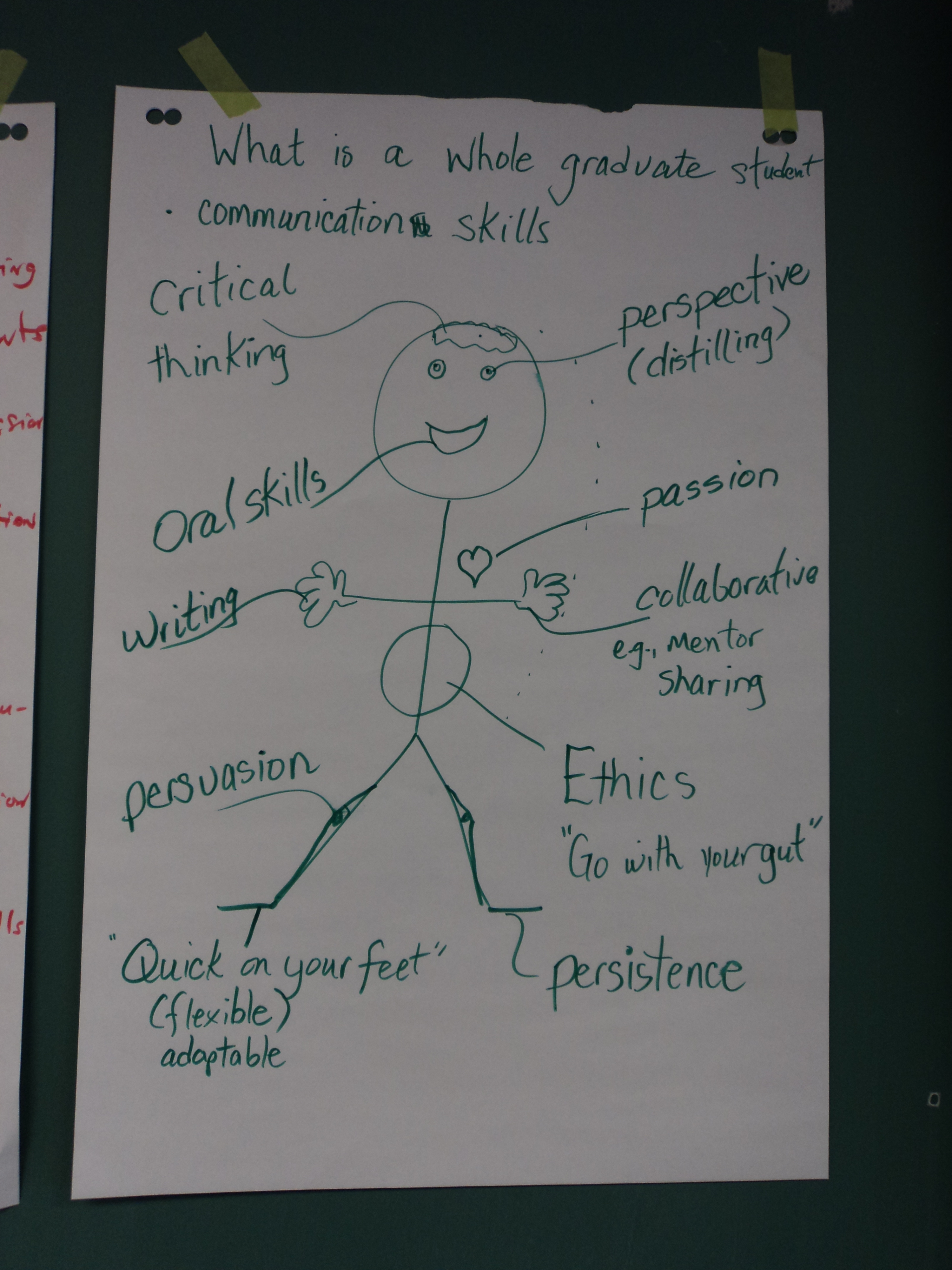
Finally, as I mentioned last week, I was just at a conference on graduate student development. It was a great opportunity to meet with graduate students, graduate administrators, and faculty to discuss ways to support graduate students. In addition to making a presentation on the role of thesis writing in the professional development of graduate students, I was also able to attend some great sessions about other aspects of graduate student development. At one such session, we were asked to define a ‘whole’ graduate student. It was an interesting question; we all know that a graduate student is more than just an intellect, but it was fun to try to identify all the components that make up a rounded and successful graduate student. One of the members of my group had the great idea to draw a figure and then identify the different tasks associated with different parts of the figure. I loved the idea of a fully embodied graduate student, one who has to draw on all of his or her resources—intellectual, emotional, and physical—in order to meet the multifaceted demands of graduate study. Here is the image we came up with:

Photo Credit: Sophia Kapchinsky

You can see a mind for critical thinking; eyes for greater perspective; a mouth for oral presentations; a heart for passionate commitment; one hand for writing and the other for collaborative work and mentoring; a gut for ethical instincts; feet for flexibility (being ‘quick on your feet’) and persistence (being ready to ‘go the distance’); and, my favourite, knees upon which to beg for funding. Thanks to all the members of our group! I wish I had learned all of their names so I could give them full credit here.

Colons

Today I am going to talk about colons. Before we look at the stylistic advantages of using colons, let’s look at the rules of colon use. In fact, let’s look at the only rule of colon use: a colon should appear after a complete sentence. In other words, don’t put a colon in the middle of a sentence:

This paper will consider: strategy, structure, personnel, and process.

The writer has presumably used a colon here because what follows is a list. But the decision about colon use actually needs to be made on the basis of what precedes the colon. This example is no different, logically, than the following: ‘I went to the store to buy: milk and eggs.’ In both cases, the colon is redundant because the items being listed are part of the sentence. Now consider a slight modification:

This paper will consider four areas of inquiry: strategy, structure, personnel, and process.

In this case, we have a complete sentence before the colon. If we want to go on to say what those four areas of inquiry are, we need to provide that information separately. A colon allows us to indicate that what follows will provide the information necessary to complete the thought found in the first sentence. Note that what follows a colon need not be a full sentence; single words, phrases, and full sentences can all appear after a colon.

With one simple rule—a colon should appear after a complete sentence—we are ready to see the stylistic advantages of the colon. Here are the three possible versions of our example:

This paper will consider: strategy, structure, personnel, and process.

This paper will consider four areas of inquiry: strategy, structure, personnel, and process.

This paper will consider strategy, structure, personnel, and process.

The final version seems to me to be the best. The first version, as we have seen, is incorrect, and the second version, while perfectly acceptable, seems a bit ponderous. In a sentence this simple, there is no need for a full sentence to introduce a list. (I might change my assessment of the second version if these ‘four areas of inquiry’ had ongoing structural significance for the paper; in that case, identifying them as such might be valuable.) If you find yourself putting a redundant colon in the midst of a simple list, you can just take it out and carry on. If, however, you find such a colon in a more complex sentence, it may be trying to tell you something. Consider this example:

This paper will consider: the nature of strategy in the high-tech industry in the period starting in 1983, the structure, both financial and organizational, of CHX Corporation, the management of personnel in this company at this time, and the process whereby the company came to occupy such a dominant market position.

In this case, the colon—while still technically redundant—is definitely there for a reason. The author used a colon in response to an inkling that the reader would need to know that a list is coming. So, in this case, try keeping the colon and adding the requisite words to create a full sentence before that colon.

This paper will consider four areas of inquiry: the nature of strategy in the high-tech industry in the period starting in 1983; the structure, both financial and organizational, of CHX Corporation; the management of personnel in this company at this time; and the process whereby the company came to occupy such a dominant market position.

(You will see that I have also added semicolons in the place of commas between the list items; I have done so because one of the list items had internal commas, which will potentially inhibit the readers’ ability to understand the list. I will address this issue in more detail in a future post on writing effective lists.)

I will end by commenting on the way that colons can be an efficient and elegant way to convey the relationship that exists between parts of your writing. Here is a sentence that I used at the outset of this post:

 In fact, let’s look at the only rule of colon use: a colon should appear after a complete sentence.

Here a colon allows us to fulfill the promise of the first sentence without belabouring the point. We don’t have to say ‘In fact, let’s look at the only rule of colon use, which is that a colon should appear only after a complete sentence.’ The version with the colon is, in my view, preferable since it uses fewer words and avoids a commonplace pattern of subordination.

If you have questions about colons or thoughts about the role they play in academic writing, please leave them in the comments below.

Using Resources for Thesis Writing

As a graduate writing instructor, I think about thesis writing much of the time. And this week I am thinking about the topic even more than usual. I am starting a new thesis writing course this afternoon, and I am making a presentation at a conference on Friday on thesis writing as professional development. Since thesis writing is all that I’ll be thinking about anyway, I thought I would devote today’s post to the idea of using resources for thesis writing.

In my presentation on Friday, I am going to discuss how a thesis writing course can be a valuable form of professional development for graduate students. Simply put, writing instruction becomes professional development when it focuses on the writer rather than on a particular piece of writing. As long as thesis writers see their goal as merely surviving the ordeal of writing a thesis, they are not likely thinking about their long-term development as academic writers. My presentation will focus on two ways that thesis instruction can encourage this sort of professional development. First, a thesis course can present the notion of thesis as genre, an approach which opens students’ minds to a new dimension to their responsibilities as writers; not only are they trying to complete a particular research task, they are also trying to convey that research in a form that is meaningful and valuable to the research community they seek to join. Second, a thesis course can also discuss the resources necessary for a student to thrive during the thesis writing process. It is this second aspect that I wish to touch on here today.

When I speak about resources in the thesis course, I am doing so in order to make students aware that there are so many resources available and that they can significantly improve their own writing process by availing themselves of such resources. Too often, I encounter students whose ‘writing resource’ is their supervisor; in some cases, of course, this works well, but more often it leaves the student feeling under-supported. Thesis writers generally need to move from thinking of themselves as fully dependent on a supervisor to thinking of themselves as developing academic writers who can take advantage of a range of resources. The sort of resources I have in mind include books on thesis writing; completed theses, especially if they are linked by a shared supervisor or by similar topics, methodology, etc.; thesis writing groups; courses on thesis writing or on academic writing more generally; published work in the student’s own field; and blogs about the thesis writing process. 

Such resources are plentiful (and multiplying rapidly), so I’ll mention just one today. I particularly want to recommend The Thesis Whisperer. This site presents wide-ranging advice that is both accessible and wise. Broad topics include the writing process; working with a supervisor; the oral presentation component of thesis completion; using new technologies in the writing process; productivity and other psychological aspects of the writing process; publishing considerations; and general research support. Anyone writing a thesis will find some parts of this advice, with its warm and supportive tone, helpful and relevant. It is impossible, of course, for any source of support to be universally applicable; a necessary part of using a broad range of resources is developing the ability to distinguish between advice that is appropriate for your circumstance and advice that would be better suited for someone else (for instance, someone working in a different country or someone from a different discipline or someone with a different theoretical framework). That is, even the most general advice is inevitably rooted in a particular context, and we all must learn to ‘read’ advice and support in such a way that its value for us becomes apparent.

Taking advantage of an expanding range of resources is a way of improving the thesis writing process. Although we all know that we are not actually the first person ever to write a thesis, many of us instinctively approach our writing life as though we were. Figuring it out as we go along; hoping for the best; using trial and error to make key decision; treating a supervisor as the only source of support and feedback—all of these strategies tend to isolate us and keep us unnecessarily apart from the community of thesis writers. If you are writing a thesis, take stock of your current situation so that you can find the resources that will ultimately improve your life as a writer.