Tag Archives: Thesis writing

Can You Write Too Early?

The Thesis Whisperer had a guest post this week with the headline Why writing from day one is nuts.* The suggestion that writing early isn’t a good idea runs directly counter to a great deal of thesis writing advice (including that given in this blog). The post, written by James Hayton (who blogs at The Three Month Thesis), posits that writing from the get-go is unproductive. Hayton argues that writing done early isn’t useful because the writer will struggle to know what to say, will produce weak writing, and will end up with a morass of text that will be hard to transform into something usable. He also claims that early writing can be an ill-advised attempt to impress, but I think this is more a personal experience than a general problem. Finally, he talks about the danger of too much writing—and, yes, I did find that a difficult phrase to type!—because writing without an immediate goal may get us in the habit of not finishing our projects. I will return to this point below, after looking at his main point: that early writing will be poorly informed, weak, and hard to work with. I agree that this might happen (who hasn’t found themselves with exactly that sort of writing?), but I think that the value of the act of writing outweighs those weaknesses.

Hayton’s estimation that early writing is likely to be flawed is based on a notion of writing as product: according to this view, we write simply in order to get a text for some purpose or other. Needless to say, writing to get a product is a very common experience, and I agree that the most efficient way to get the right product is to work from the clearest possible understanding of the task. For instance, if you need to write an article response, starting to write before reading the article or grasping the goals of the assignment would be a terrible idea. But waiting to write a thesis until you have a clear understanding of the task will mean that you won’t use writing as a way of figuring out that task and that you won’t be practicing crucial writing skills. This is where Hayton loses me. Most thesis writers that I see—from across all disciplines—need to write more, not less. Bad writing, of a sort, will come from early writing, but so will a growing understanding of the underlying issues. The key is accepting that early writing will take work or may even be unusable.

What about Hayton’s claim that early writing gets us into the bad habit of writing without finishing? I’m afraid I can’t see any way that makes sense. So much of academic writing is part of a process that will lack an immediate connection to finishing. (Blogging, it must be said, is awesome for the amount of finishing there is.) Writing is common; finishing is rare. And the one thing that would improve the lives of most of the academic writers I know is the habit of writing. Comfort with the writing process gives us confidence and creativity. We can experiment and push ourselves and avoid writer’s block. In my view, cultivating the habit of writing tops the list of reasons to write early.

I’m also a little uneasy with Hayton’s tone. While he began his post with a genial statement about his own willingness to be corrected, he also expressed a clear commitment to an approach to writing and research that transcends disciplinary difference. I am always concerned when advice to graduate students is both highly contentious and narrowly informed. To put it simply, I have no problem with Hayton relating an anecdote about writing too early in an attempt to impress, an anecdote that I am sure will resonate with lots of people; I do object to his suggestion that this possibility is a reason why others—who might have very different motivations—should not be writing early. Overall, I think it is important to give doctoral writing advice that is limited and that helps novice academic writers to understand their disciplinary conventions and their own temperament as writers. I think Hayton does his own argument a disservice by overextending it; taking his experience with scientific writing and suggesting that he has a cure for what ails the humanities is an over-reach that threatens to undermines the value of his insights.

All that said, I do think Hayton sounds a useful note of caution about the call to write early. If you write early, you need to be aware of two things. First, you need to understand that your fundamental task will be to make your thinking concrete in order to allow you to advance that thinking; if you make the mistake of trying to create the final product too soon, you will probably be frustrated. Some students do write ‘too early’ in the sense that they try to create a finished product too soon; early writing, in my view, must be characterized by a certain openness, a willingness to change, discard, and move into new and more productive directions. Second, when you are writing as a process, you need to be able to work with the product. Hayton is right that there is always an artifact of the act of writing, and we all need strategies for doing something with that artifact. If we lack those strategies, we may end up in the situation he describes: with a messy provisional document that is—in its current form—unusable. But rather than concluding that we should put off writing, I would argue that we should deepen our understanding of the writing task. We should be writing early and writing often because doing so can deepen our intellectual insights and strengthen our writing skills.

*James Hayton has removed his original post from The Thesis Whisperer site; he explains his reasons for doing so in a comment below. You can find a helpful list of all his posts on his own site here.


The Supervisory Relationship

This blog aims to present both my own ideas about graduate student writing and my commentary on other people’s ideas. I’ve struggled a bit with the best way to do the latter. I find that I often draft comments about interesting things I’ve read, but then don’t post them (because writing is easy, sharing your writing is hard!). Those sort of reflections can quickly become stale, so they end up sitting unused in a draft folder. Increasingly, I just share the things that I find interesting on Twitter; the commentary aspect is lost, but at least the sharing is timely. Since not everyone follows me on Twitter (@explorstyle), I am going to start including a list of the things I’ve shared on Twitter at the end of these posts. The post itself will consist of a comment on one recent item of interest. Today’s link isn’t particularly recent (unless, like me, you feel like July was just a minute ago!), but I know that it is one that graduate students will find relevant.

This post from the Thesis Whisperer blog on what doctoral students need from their supervisors highlights the potential for difficulties in the supervisory relationship. The post discusses what doctoral students can and should expect from their supervisors—and whether that relationship needs to be as fraught as it so often is. The post was inspired the actions of a new doctoral student who was looking to avoid the inevitable pitfalls. I thought the post did a great job of summing up two equally undesirable poles: one, avoiding all rookie mistakes or, two, suffering through every indignity that every doctoral student has ever endured. Surely neither of those extremes is ideal. Although a PhD is never going to come without some struggle, the process shouldn’t be a source of actual trauma. We all hear far too many stories about the misery caused by inadequate supervisory relationships; the Thesis Whisperer’s characterization of her role as that of a ‘global agony aunt’ is telling.

In general, I believe that the uneven quality of supervision, while unfortunate, must not be allowed to derail the writing process. Instead, the thesis writer needs to see themselves as capable of gaining the necessary expertise from a range of resources. Ideally, the supervisor will figure heavily in the writer’s development, but an unwilling or inexpert supervisor needn’t signal doom for the writer. And while I don’t think that the goal of supervision should be to make sure that each generation suffers as much as the last, I do know that trial and error can be an invaluable route to meaningful expertise. A good supervisor is many things, but not necessarily a protection against travelling down unproductive pathways. Those pathways are crucial—not to replicate a needless tradition of suffering but rather to give thesis writers the depth of experience necessary to complete this demanding and defining writing task.

Recent links from @explorstyle on Twitter

I love this cartoon from @xkcdhttp://xkcd.com/1108

More good advice from @GradHacker on successfully navigating conferences: http://www.gradhacker.org/2012/09/17/successfully-navigating-conferences-part-2/

From @GradHacker, a post on getting our ideas down on paper, so they don’t keep us up at night! http://www.gradhacker.org/2012/09/14/write-it-down-go-to-sleep/

From @ProfHacker, a post on the things that we should make easier and those that we should make harder: http://chronicle.com/blogs/profhacker/make-it-hard-on-yourself/42568

From @chronicle, something to make you laugh and feel better about your own presentation mishaps! http://chronicle.com/blogs/onhiring/when-your-presentation-goes-awry/33710

@scholarlykitchn says the exact right thing about PowerPoint and Prezi: http://wp.me/pcvbl-77T

From the NYT, a clear discussion of the subjunctive in the always-delightful After Deadline blog: Save the Subjunctive! http://nyti.ms/QgRZQE 

From Barbara Fister, a very nuanced take on the way we talk about plagiarism: The Plagiarism Perplex http://www.insidehighered.com/blogs/library-babel-fish/plagiarism-perplex

From @chronicle, a call for reverse mentoring: http://chronicle.com/blogs/conversation/2012/09/06/why-we-need-reverse-mentoring/

The recent @GradHacker podcast on productivity systems is full of interesting and helpful insights: http://podcast.gradhacker.org/?p=122

From @ProfHacker, a helpful overview of Twitter for academics: http://chronicle.com/blogs/profhacker/how-and-why-to-participate-in-a-tweetchat/42380

From @GradHacker, a useful discussion of the pros and cons of Prezi: http://www.gradhacker.org/2012/08/29/prezi-a-dynamic-presentation-or-nauseating-experience/

I love this post from @stancarey on the choice between following bad rules or standing up to their eternal enforcers: http://wp.me/pglsT-3o7

Literature Reviews and Reverse Outlines

After a recent discussion of reverse outlines on Twitter, I had a flurry of visits to my reverse outlines post. The Twitter conversation concerned reverse outlining as a way to help with literature reviews, so I thought it might be useful to spell out that connection more explicitly. A reverse outline is a great way to address the most common flaws of lit reviews: poor organization and poor articulation of research goals. These two issues are closely connected, but I am going to discuss them in turn.

I’m sure I don’t need to describe how poor organization bedevils lit reviews; the sheer volume of the material makes organizational difficulties near inevitable. The organizational scheme that you must devise is also a genuinely conceptually complex task. It is not like organizing your sock drawer; organizing your lit review requires a deep understanding of your project and its connection to the existing literature in your field. While a reverse outline won’t magic away difficulties, it will help you to confront the limitations of your early drafts. The beauty of a reverse outline is that it prunes away the distracting details, allowing you to see the underlying structure.

Let’s look at a sample reverse outline in order to get a sense of how this might work. As you likely know, the unit of analysis in a reverse outline is the paragraph. We number each paragraph and then ask ourselves some basic questions: What is the topic? Is there a topic sentence? Does the whole paragraph have thematic unity? For a more detailed explanation of this process, you can go back to the original reverse outlines post.)

Sample Reverse Outline:

1. The research into X
• However, there are also a few sentences on Y.
• No topic sentence found (although this might be okay if the whole paragraph functions as an introduction to a particular topic).

2. The historical background to X
• No topic sentence found.
• The paragraph is purely chronological with no thematic starting point.

3. The work of Singh and Johnson, who also study X
• No topic sentence found.

4. The main study that Singh and Johnson were responding to
• No topic sentence found.

5. The work of Gordonberg, who works on Z
• There is a clear topic sentence on Gordonberg, but no mention of Z or any link to what came before.

When we look at this reverse outline, the absence of detail helps us to see some basic problems. The truth is that many of us could have found those problems in the original if we’d read it. But chances are that we would have missed those problems in our own writing, the familiarity of which tends to lull us into a kind of editorial somnambulance. In my experience, that sleepy acceptance is often accompanied by an underlying uneasiness, but discomfort alone doesn’t break the spell. A reverse outline can be like a bucket of cold water. Often my first reaction to my own reverse outlines is ‘huh?’. Why did I put those things there? Those points are in the wrong order! That is the completely wrong organizational approach to that material! It may not be as bad as all that, but the evident weaknesses of the outline give me a sense that whatever I was trying to accomplish may not yet be working on the page. I can then start to rework at the outline level without being distracted by familiar chains of words or complex details.

Revised Sample Reverse Outline:

1. The importance of X, Y, and Z to my research project
• This paragraph will serve as an introduction to the subsequent discussion of X, Y, and Z, so may not have an obvious topic sentence.
• This paragraph may be short or long—or may even need to be broken into multiple paragraphs—depending on how difficult it is to establish the relevance of this topic to your research.

2. The research into X
• This could be more than one paragraph, of course, depending on the amount of material.
• The first version had a historical background paragraph; if that topic does warrant its own paragraph, think about whether you will be giving similar historical background to Y and Z. Another possibility would be that you need a combined historical background to X, Y, and Z; it is very common to speak about the historical background in a more unified way before dividing the field into its important sub-fields. As a simple example, consider the following sequence of sentences: ‘Serious scholarly attention to [topic] began in …’/‘For the next twenty years, scholars tended to …’/‘By the mid-1980s, however, a serious rupture began to emerge about …’/‘In subsequent years, the scholarly approach was often divided into X, Y, and Z’.
• What about Singh and Johnson? Were they included as an example of the work done on X? Are other thinkers being included? Why are they so important? Is the study that they are responding to important for you or is it just important for them?

3. The research into Y
• Try to follow whatever pattern you have established with your discussion of X; the length can vary, but the reader will expect X, Y, and Z to be treated in a roughly parallel fashion. If that parallel structure proves hard to sustain as you are writing, you may need to revisit your initial structural scheme.

4. The research into Z
• The discussion of Z should follow the broad pattern established in the discussion of X and Y.

As you’ve probably noticed, the modifications in the reworked outline also address the second common flaw in lit reviews, the tendency of authors to obscure their own research goals. Singh and Johnson may be significant researchers in their own right, but the reader can always go directly to them for their research. What the reader needs from you is a clear explanation of the way that the existing research serves as a backdrop or source or inspiration for your own. The reworked outline is stronger because it is better organized but also because it links each paragraph into the broader agenda of the author.

In their valuable book Helping Doctoral Students Write, Kamler and Thomson give a great collection of student metaphors for lit review writing (pp. 32–34). In my thesis writing course, I usually read those metaphors aloud to students and ask which one most closely represents each of their experiences. My favourite is the image of someone trying to put an octopus into a bottle. A reverse outline can be a way to convince your octopus to coordinate all its limbs in service of your research plan.

My Very Own Blog

I think it’s probably a bad sign when your own blogging delinquency becomes your subject matter for a post. As I’ve said before, I understand that neither apologies nor explanations of the worthiness of my non-blogging activities are of any interest. But I do actually have something to say about blogging and not blogging.

Patrick Dunleavy and Chris Gilson, in an interview in the Impact of Social Sciences blog, said recently that we ought to move past the idea of single-authored blogs. They make a good argument for the value of the multi-authored blog: the group blog benefits from the emphasis on collaboration and from the sharing of the responsibility among many writers. The collaborative approach, they suggest, also benefits the audience since a multi-authored blog is much more likely to be updated regularly. According to estimates that Dunleavy and Gilson mention, eighty per cent of single-author blogs are either inactive or rarely updated; they call these ‘desert blogs’, which is such a sad phrase (I tried to find out if this was their coinage or an established term, but all I found were a lot of gorgeous dessert blogs!). Reading their stark assessment of single-authored blogs made me want to defend my little solo project, but I was constrained by my awareness of the stale post that had been sitting on my site for over a month.

What does all this mean for my neglected single-author blog? I assume that nobody is wasting their time checking my blog for new content; you all have better things to do and anyone who cares to can receive some form of notification (all the notification options can be found in the left sidebar: email, RSS, Facebook, Twitter). Given the rhythms of my work life, I accept that this blog will need to be a some-times-more-than-other-times proposition. Despite the inevitable fallow times, I know that this blog benefits from having a single author.

A blog that offers an approach to writing needs authorial consistency to allow readers a chance to evaluate its value for them. I think you’d be crazy to show up here out of the blue and accept what I say. Taking the writing process seriously means not accepting one-size-fits-all ‘writing tips’. You need to find a source of writing insight that addresses your general writing situation and that resonates with your specific approach to writing. I’m not saying that a group blog on writing can’t be valuable, of course; the Lingua Franca blog is a great example of a blog that is consistently updated and consistently excellent. But the multi-author model doesn’t encourage the same sustained interaction between a single author and the audience. Given the nature of my project, that sustained interaction is important to me.

All of which is to say that I’m committed to this blogging format. But this ‘commitment’ raises an obvious question: why don’t I write here more often? The reason isn’t a lack of enjoyment—writing here is one of my very favourite things to do. And the enjoyment isn’t just derived from the creative process; I love knowing that the posts are read, shared, and used across a wide range of networks. The act of writing these posts is also very helpful to me as a teacher; crystallizing my thoughts about writing allows me to teach these topics more effectively in the classroom.

This rosy picture makes blogging sound like a winning proposition all around. But there is, unfortunately, a predictable impediment: this blog is all mine and thus I’m not responsible to anyone else for what happens here. Everything else in my professional life involves some degree of obligation to other people: preparing to teach; looking at student writing; handling administrative responsibilities; meeting with colleagues; making presentations. These are all things that I genuinely enjoy doing, but the manner in which I do them means that a failure to do so would negatively affect someone else. Blogging—or not blogging, as the case may be—is something that matters only to me. As such, it is the first thing to go when I am busy. Sound familiar? Where does writing fit into the have to/would really like to split in your own life?

The problem for many graduate students is that they have to write, but their lives end up organized in such a way that writing is neglected in favour of other things that feel more urgent. That sense of urgency is real, of course; the non-writing activities of graduate students aren’t just hobbies. Often those activities generate essential income or develop key professional competencies. But successful writers will find a way to place writing within the confines of their essential activities. I realize this sounds like a very self-serving conclusion: it’s okay if I can’t find time to blog, but it’s not okay if you don’t find time to write your thesis. Convenient, perhaps, but also true. The more you can think of writing as an obligation, the more progress you will make towards the goal of a completed thesis.

Finally, I know I said I wouldn’t bore you with what I’ve been doing while neglecting the blog, but I can’t resist sharing a few photos from my recent trip to Savannah. I was there for the International Writing Across the Curriculum conference, and the conference and the city were both delightful!

Links: Time Enough, What Not to Do, Writing Across Boundaries

This advice from the GradHacker blog is excellent: wanting and needing more time aren’t necessarily the same thing. We almost always feel that we could use more time with our academic writing projects; when there is no objective way to determine that something is finished, we are often reliant upon our own assessment of quality. Since our assessment of our own writing is frequently negative, we end up feeling that we need more time. But it is important to ask ourselves hard questions about our writing and to be aware of the potential for diminishing returns on time spent with that writing. What is the piece of writing? Who will read it? What sort of expectations will that reader have? In other words, what is ‘good enough’ in each case? We may lack the ability to make this judgement because we habitually only stop tinkering with a piece of writing when we are out of time. But think of the value of being able to determine sufficient quality on our own. With a developed sense of what is sufficient in each case, we are more likely to devote the appropriate amount of time to each of our writing projects, without getting stuck in a cycle of unproductive revisions.

Here is a great post from The Thesis Whisperer blog on mistakes that rookie researchers make. (This post is a few months old, and I would urge everyone to read her current post on thesis writing despair, too.) I think her specific advice here is very good, but I particularly like the overall approach of the ‘reverse list’; “I like a reverse list because it highlights the problem more than the suggested solutions, leaving you free to choose your own.” The beauty of being told what not to do is that you get forceful advice that doesn’t assume it has all the answers. In other words, bossyness that doesn’t tell people what to do. Getting a PhD, needless to say, has as many ‘right ways’ to do it as there are doctoral students; while this is true, thesis writers—in their periodic moments of quiet writing desperation—aren’t looking for relativism or anodyne truisms. They want real advice, and I think the reverse list is a great way to deliver that advice: it doesn’t presume to tell you what to do, but it does use the benefit of experience to highlight some consistently unproductive paths.

The Writing Across Boundaries project from Durham University offers reflections on academic writing from established academics. These reflections—varied and extremely interesting—give novice writers a chance to see that polished and assured academic writing is still accompanied by struggle and self-doubt. These reflections all come from social science writers, but I think their insights are applicable to the broader academic writing community.

My links posts are a discussion of things (articles, news items, or blog posts) that I have recently found interesting. I choose things that are connected—sometimes closely, sometimes only tangentially—to academic writing. Responding to other people’s ideas allows me to clarify my own thoughts and to draw your attention to other approaches to the issues central to this blog.

The Faintest Ink

Every other week, this space is devoted to a discussion of things (articles, news items, or blog posts) that I have recently found interesting. I choose things that are connected—sometimes closely, sometimes only tangentially—to academic writing. Responding to other people’s ideas allows me to clarify my own thoughts and to draw your attention to other approaches to the issues central to this blog.

Most of my links posts come from the range of links that I archive during my daily reading. But this one instead comes from something that came up in class and that was then reinforced by some comments in my Twitter feed. In my thesis writing course, we were recently talking about the perils of not writing ideas down when first they strike. In fact, I was stressing the importance of doing more than just jotting down an idea. In most cases, we need to elaborate on the idea so that it may be useful to us later; that is, we need to explain how that idea might play out or why it might ultimately matter or how it relates to our own work. It can be a pain to stop whatever else we are doing when inspiration strikes, but I have learned that finding an old idea without any elaboration is usually a baffling experience. It seems to be human nature to imagine that our future selves will have tremendous recall especially concerning matters that are clear to our current selves. Do you ever find these sort of cryptic notes in your files? ‘This connects to an earlier idea expressed by the second speaker in the fourth panel: it’s a dichotomy’. I made that up, obviously, but have a look at your own conference notes. Chances are, they are full of obscurity (this?), references requiring context (second speaker? fourth panel?) and words that fail to convey any enduring meaning (dichotomy?). It can be a painful experience to find one of these inexplicable notes. Imagine yourself triumphantly concluding ‘it’s a dichotomy!’ and obviously thinking that this was a valuable insight. And maybe it was, but now you’ll never know.

While I was reflecting on this issue, I saw a tweet from @RohanMaitzen that summed this phenomenon up nicely: “Now, if I could only remember why the word ‘superfluity’ seemed so important to my Eugenides review that I got out of bed to write it down.” She later tweeted that she had remembered the significance of superfluity, so her story has a happy ending. Shortly thereafter, I saw the following tweet from @thesiswhisperer: “I had 3 great ideas for my new workshop ‘If the CV is dead, what should I do?’ but was at gym and didn’t write it down. damn.” (I’m not sure how her story turned out, although I have every confidence that her CV workshop was great.) I even encountered a discussion of this phenomenon on Mad Men. In Season Three, there was an episode called ‘The Color Blue’ in which Paul woke up—hungover and still at the office—remembering that he had had a great idea for a campaign but with no memory of what it had been and, more significantly, with no written notes. Peggy encouraged him to tell Don the truth, and he reluctantly agreed, expecting a full measure of Draper scorn. But Don surprised him: he wasn’t scornful, he was sympathetic. The only explanation for this unexpected burst of human kindness is that even Don Draper understands that ideas get forgotten if they aren’t written down. The Chinese proverb that Paul quotes in despair is the perfect expression of this idea: ‘The faintest ink is better than the best memory.’

So, unless you have been granted a freakishly good memory, make it your basic assumption that you won’t remember later what seems obvious to you now. Write it all down with an eye to your future self: make sure that you note whatever you will need in order to work with this idea in a week or a month or however long it is likely to be before you’ll have a chance to return to this idea.

Finally, some related links. Here is a helpful blog post from The Thesis Whisperer with some guidance on how to use a notebook effectively during your graduate study. The ProfHacker blog recently addressed how to make notes on the go. If you are more likely to take notes on a computer or mobile device, here is an overview of Evernote, also from the ProfHacker blog. And if all else fails, maybe the post-it watch will help you when sudden inspiration strikes.

Links: Editing Yourself, Blogging Your Reflections, Dancing Your PhD

Here is some advice from a professional editor about the types of editing we should be doing for ourselves. Writing in The Chronicle of Higher Education’s new writing blog, Lingua Franca, Carol Saller offers some tips for self-editing (my approach to this topic can be found here). I particularly liked her reminder that we do a lot of damage through editing itself. Not that we shouldn’t edit—obviously!—but we should be aware that we create a different class of errors through editing than we do through writing. We need to know what our typical writing errors are, but we also need to be aware of the sort of problems we may be inadvertently creating when ostensibly improving our writing through editing. Saller mentions the various ‘cut and paste’ errors that result from moving text around (for instance, repetition and non sequiturs). I would add two more. At the sentence level, be very careful with forms of agreement—for instance, subject and verb or noun and pronoun—when making changes. At a broader level, make sure that all changes are reflected in the language that we use to refer to our own text; for instance, if we decide to reorder a set of points, we must be sure to go back and change the sentence where those points were first introduced. In general, we need to think—especially in late-stage editing—about all the connections that exist in our text. Some sentences stand alone and can be changed solely according to their own demands. But many more sentences stand in relation to others; in those cases, we must be cognizant of how local changes can have a broader impact.

Writing in The University of Venus blog, Lee Skallerup Bessette recently offered her thoughts on the formal demands of a blog post. She offers an interesting breakdown of the general types of academic blog posts and then defends the value of posts that are reflective rather than definitive.

The fourth annual Dance Your PhD contest is coming to a close. I believe the winner will be announced today! If you have never watched these wonderful (and wonderfully odd) videos, you are in for a treat. I’m amazed every year at how they manage to illustrate complex scientific concepts in manner both effervescent and earnest.

Finally, we have reached another day of note. A few weeks ago, you may recall, I looked into the phenomenon of national days of any-old-thing. But today is different: it is the official National Day on Writing. It’s official because the United States Senate passed Resolution S.298 saying so. I hope you won’t let this special day go by without some quiet time alone with your thoughts and a writing instrument of some kind!

Links: Feedback for Thesis Writers, Post-Academic Careers, Limitations of Spellcheck

Here is an interesting discussion from Rachel Toor in The Chronicle of Higher Education about the writing feedback that is given to thesis writers. Surprisingly, she is discussing what to think when someone says that you ‘write too well’! Toor addresses two possible meanings of this odd utterance. First, she discusses the idea that good writing is somehow inappropriate and suspect in a dissertation. Second, she considers whether ‘you write too well’ is a sort of code for ‘your ideas aren’t that good’. Needless to say, using the term ‘good writing’ as that sort of backhanded compliment would be an outrageous misuse of the term. Toor sums up what one should do if confronted by this unexpected comment: “… if someone ever tells you that you write too well, ask him for an explanation and be prepared to hear something that will cause you to do more work. If, however, he proceeds to make the case that the language shouldn’t matter in scholarly writing, that clarity isn’t important, that good sentences are a waste of academic time, sue that idiot for scholarly malpractice.”

This recent column, also from The Chronicle of Higher Education, covers familiar ground: the graduate student experience. Between the article itself and the vigorous comment stream, the pertinent issues—micro and macro—are well covered. I kept the link but thought it unlikely that I would include it here—what else is there to add? But then I saw this related but very different post from the ProfHacker blog on post-academic careers; the post highlights the value of a good understanding of our professional options and our own vocational inclinations. My question, after reading these two articles, is how the narrative of graduate student misery affects the development of such awareness. It seems possible that the general and accepted level of unhappiness about graduate school may serve to obscure specific unhappiness. If all graduate students are miserable and expected to be so, how does any individual graduate student learn that he or she might just not like this type of work? Similarly, it can be hard to interpret the pleasure derived from non-academic work when such work is often framed as nothing more than an illegitimate way of avoiding the legitimate tasks of academic work.

Lastly, here is something fun on the limitations of spellcheck programs. You’ve probably read or seen something like this before, but Taylor Mali’s enthusiastic wordplay (and occasional profanity) is sure to focus your attention on what your spellchecker might be missing.

Links: Supporting Scientific Innovation, Libraries and Abundance, Writing to Your Dissertation

Explorations of Style will be taking next week off; I have to travel for a conference and, first, to make that travel worthwhile, have to write the paper I will be presenting at the conference. The presentation is on the role this blog plays in my classroom teaching, so don’t imagine the lack of posts means I’m not still thinking about the blog all the time. I will return with something new—or at least something adapted from my presentation on blogging and teaching—on June 1st. See you then! I will leave you with a few weekly links.

Here is a great piece from Slate on the best model for funding innovative scientific work. Tim Harford offers a fascinating discussion of the relationship between funding—both public and private—and scientific progress.

While I don’t know much about libraries, I am sure that those of us who benefit from university libraries ought to listen to what librarians have to say about the sustainability of the current model of managing collections. Here is something from Barbara Fister, writing at Inside Higher Ed. I particularly like the way she uses a food analogy, stressing the need to think about sustainability even in the face of apparent abundance.

Finally, from McSweeney’s, here is someone’s letter to his dissertation. This letter is part of their series of ‘Open letters to people or entities who are unlikely to respond’. I am obliged, of course, to say that you would be better off writing your dissertation than writing to your dissertation. But I found this line funny: “You probably sense that I am a little frustrated, the way that I spend time with you every day but it’s never quality time, the way you are always on my mind but we never seem to get anywhere.” (Thanks to The Thesis Whisperer for the link.) If you spend any time with your thesis over the weekend, I hope it is quality time.

Links: Communicating Research, Understanding Procrastination, Drawing Pictures

From Inside Higher Ed, here is something on explaining doctoral research in general terms. It is easy to see why the PR department of a university might be interested in having doctoral students or recent graduates who can comment cogently on their work for a general audience. But I think this ability can also be great for you as a writer. In the first place, being able to give a ready account of your work will boost your confidence; it never feels good to stumble over an explanation of the project to which you have devoted your whole life. And the clarity and simplicity that you achieve when you encapsulate your research will always help you to understand it better.

Also from Inside Higher Ed, here is something on procrastination. This article reviews a new book by Piers Steel, The Procrastination Equation: How to Stop Putting Things Off and Start Getting Stuff Done. I particularly liked how the article referred to Steel as a ‘procrastination expert’; I am pretty sure we all think of ourselves as procrastination experts! The point that jumped out at me in the interview with Steel was his comment on procrastination among people who are ABD: “Doing any major task for the first time is extremely hard motivationally as you don’t have a firm mental image of what you are supposed to be doing.” It’s a simple point, but still a profound one. Not being able to see the full trajectory of the project can leave us uncertain and thus prone to procrastination.

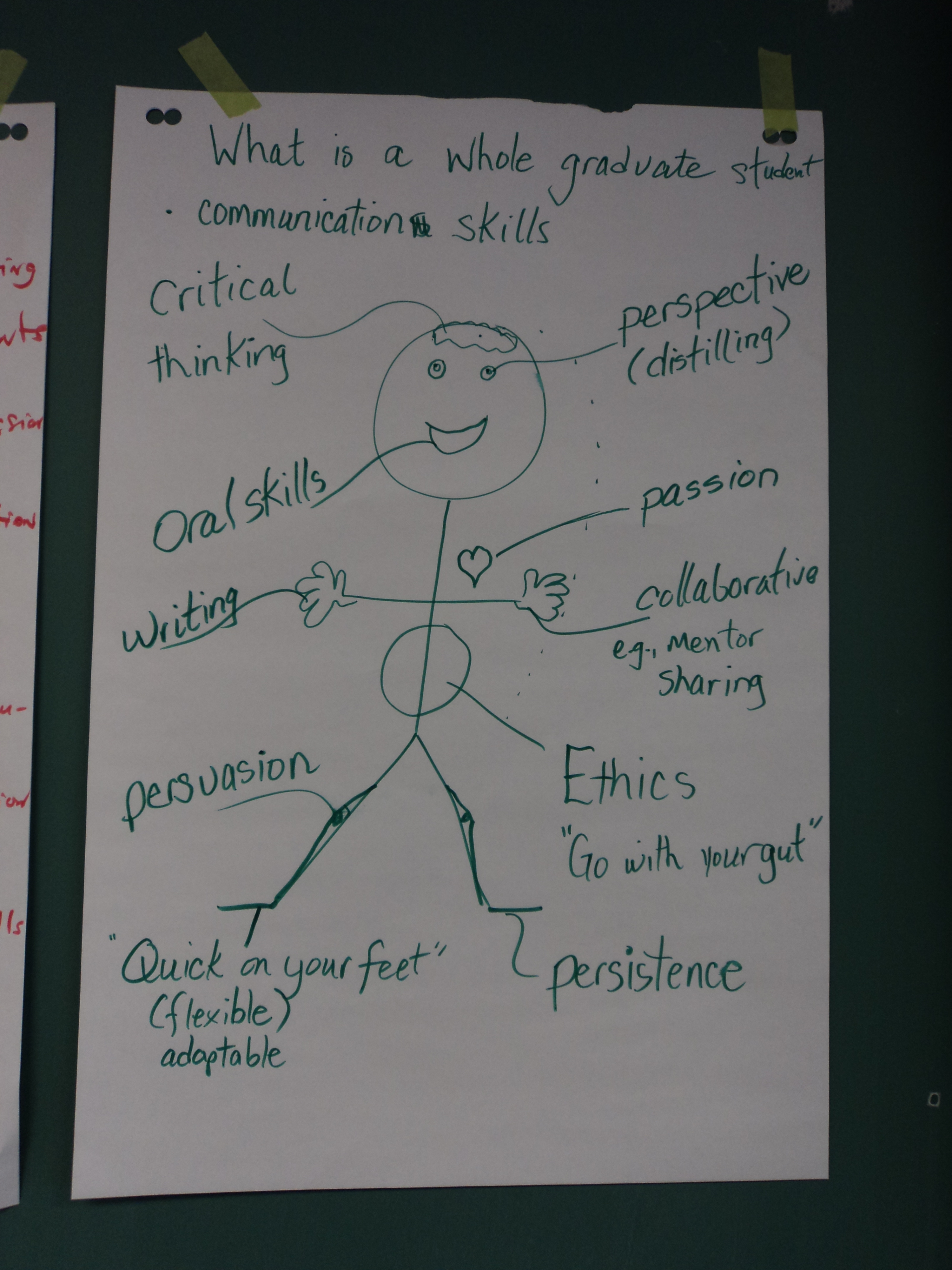
Finally, as I mentioned last week, I was just at a conference on graduate student development. It was a great opportunity to meet with graduate students, graduate administrators, and faculty to discuss ways to support graduate students. In addition to making a presentation on the role of thesis writing in the professional development of graduate students, I was also able to attend some great sessions about other aspects of graduate student development. At one such session, we were asked to define a ‘whole’ graduate student. It was an interesting question; we all know that a graduate student is more than just an intellect, but it was fun to try to identify all the components that make up a rounded and successful graduate student. One of the members of my group had the great idea to draw a figure and then identify the different tasks associated with different parts of the figure. I loved the idea of a fully embodied graduate student, one who has to draw on all of his or her resources—intellectual, emotional, and physical—in order to meet the multifaceted demands of graduate study. Here is the image we came up with:

Photo Credit: Sophia Kapchinsky

You can see a mind for critical thinking; eyes for greater perspective; a mouth for oral presentations; a heart for passionate commitment; one hand for writing and the other for collaborative work and mentoring; a gut for ethical instincts; feet for flexibility (being ‘quick on your feet’) and persistence (being ready to ‘go the distance’); and, my favourite, knees upon which to beg for funding. Thanks to all the members of our group! I wish I had learned all of their names so I could give them full credit here.