
Tag Archives: Professional development

Can You Write Too Early?

The Thesis Whisperer had a guest post this week with the headline Why writing from day one is nuts.* The suggestion that writing early isn’t a good idea runs directly counter to a great deal of thesis writing advice (including that given in this blog). The post, written by James Hayton (who blogs at The Three Month Thesis), posits that writing from the get-go is unproductive. Hayton argues that writing done early isn’t useful because the writer will struggle to know what to say, will produce weak writing, and will end up with a morass of text that will be hard to transform into something usable. He also claims that early writing can be an ill-advised attempt to impress, but I think this is more a personal experience than a general problem. Finally, he talks about the danger of too much writing—and, yes, I did find that a difficult phrase to type!—because writing without an immediate goal may get us in the habit of not finishing our projects. I will return to this point below, after looking at his main point: that early writing will be poorly informed, weak, and hard to work with. I agree that this might happen (who hasn’t found themselves with exactly that sort of writing?), but I think that the value of the act of writing outweighs those weaknesses.

Hayton’s estimation that early writing is likely to be flawed is based on a notion of writing as product: according to this view, we write simply in order to get a text for some purpose or other. Needless to say, writing to get a product is a very common experience, and I agree that the most efficient way to get the right product is to work from the clearest possible understanding of the task. For instance, if you need to write an article response, starting to write before reading the article or grasping the goals of the assignment would be a terrible idea. But waiting to write a thesis until you have a clear understanding of the task will mean that you won’t use writing as a way of figuring out that task and that you won’t be practicing crucial writing skills. This is where Hayton loses me. Most thesis writers that I see—from across all disciplines—need to write more, not less. Bad writing, of a sort, will come from early writing, but so will a growing understanding of the underlying issues. The key is accepting that early writing will take work or may even be unusable.

What about Hayton’s claim that early writing gets us into the bad habit of writing without finishing? I’m afraid I can’t see any way that makes sense. So much of academic writing is part of a process that will lack an immediate connection to finishing. (Blogging, it must be said, is awesome for the amount of finishing there is.) Writing is common; finishing is rare. And the one thing that would improve the lives of most of the academic writers I know is the habit of writing. Comfort with the writing process gives us confidence and creativity. We can experiment and push ourselves and avoid writer’s block. In my view, cultivating the habit of writing tops the list of reasons to write early.

I’m also a little uneasy with Hayton’s tone. While he began his post with a genial statement about his own willingness to be corrected, he also expressed a clear commitment to an approach to writing and research that transcends disciplinary difference. I am always concerned when advice to graduate students is both highly contentious and narrowly informed. To put it simply, I have no problem with Hayton relating an anecdote about writing too early in an attempt to impress, an anecdote that I am sure will resonate with lots of people; I do object to his suggestion that this possibility is a reason why others—who might have very different motivations—should not be writing early. Overall, I think it is important to give doctoral writing advice that is limited and that helps novice academic writers to understand their disciplinary conventions and their own temperament as writers. I think Hayton does his own argument a disservice by overextending it; taking his experience with scientific writing and suggesting that he has a cure for what ails the humanities is an over-reach that threatens to undermines the value of his insights.

All that said, I do think Hayton sounds a useful note of caution about the call to write early. If you write early, you need to be aware of two things. First, you need to understand that your fundamental task will be to make your thinking concrete in order to allow you to advance that thinking; if you make the mistake of trying to create the final product too soon, you will probably be frustrated. Some students do write ‘too early’ in the sense that they try to create a finished product too soon; early writing, in my view, must be characterized by a certain openness, a willingness to change, discard, and move into new and more productive directions. Second, when you are writing as a process, you need to be able to work with the product. Hayton is right that there is always an artifact of the act of writing, and we all need strategies for doing something with that artifact. If we lack those strategies, we may end up in the situation he describes: with a messy provisional document that is—in its current form—unusable. But rather than concluding that we should put off writing, I would argue that we should deepen our understanding of the writing task. We should be writing early and writing often because doing so can deepen our intellectual insights and strengthen our writing skills.

*James Hayton has removed his original post from The Thesis Whisperer site; he explains his reasons for doing so in a comment below. You can find a helpful list of all his posts on his own site here.
 

The Supervisory Relationship

This blog aims to present both my own ideas about graduate student writing and my commentary on other people’s ideas. I’ve struggled a bit with the best way to do the latter. I find that I often draft comments about interesting things I’ve read, but then don’t post them (because writing is easy, sharing your writing is hard!). Those sort of reflections can quickly become stale, so they end up sitting unused in a draft folder. Increasingly, I just share the things that I find interesting on Twitter; the commentary aspect is lost, but at least the sharing is timely. Since not everyone follows me on Twitter (@explorstyle), I am going to start including a list of the things I’ve shared on Twitter at the end of these posts. The post itself will consist of a comment on one recent item of interest. Today’s link isn’t particularly recent (unless, like me, you feel like July was just a minute ago!), but I know that it is one that graduate students will find relevant.

This post from the Thesis Whisperer blog on what doctoral students need from their supervisors highlights the potential for difficulties in the supervisory relationship. The post discusses what doctoral students can and should expect from their supervisors—and whether that relationship needs to be as fraught as it so often is. The post was inspired the actions of a new doctoral student who was looking to avoid the inevitable pitfalls. I thought the post did a great job of summing up two equally undesirable poles: one, avoiding all rookie mistakes or, two, suffering through every indignity that every doctoral student has ever endured. Surely neither of those extremes is ideal. Although a PhD is never going to come without some struggle, the process shouldn’t be a source of actual trauma. We all hear far too many stories about the misery caused by inadequate supervisory relationships; the Thesis Whisperer’s characterization of her role as that of a ‘global agony aunt’ is telling.

In general, I believe that the uneven quality of supervision, while unfortunate, must not be allowed to derail the writing process. Instead, the thesis writer needs to see themselves as capable of gaining the necessary expertise from a range of resources. Ideally, the supervisor will figure heavily in the writer’s development, but an unwilling or inexpert supervisor needn’t signal doom for the writer. And while I don’t think that the goal of supervision should be to make sure that each generation suffers as much as the last, I do know that trial and error can be an invaluable route to meaningful expertise. A good supervisor is many things, but not necessarily a protection against travelling down unproductive pathways. Those pathways are crucial—not to replicate a needless tradition of suffering but rather to give thesis writers the depth of experience necessary to complete this demanding and defining writing task.

Recent links from @explorstyle on Twitter

I love this cartoon from @xkcdhttp://xkcd.com/1108

More good advice from @GradHacker on successfully navigating conferences: http://www.gradhacker.org/2012/09/17/successfully-navigating-conferences-part-2/

From @GradHacker, a post on getting our ideas down on paper, so they don’t keep us up at night! http://www.gradhacker.org/2012/09/14/write-it-down-go-to-sleep/

From @ProfHacker, a post on the things that we should make easier and those that we should make harder: http://chronicle.com/blogs/profhacker/make-it-hard-on-yourself/42568

From @chronicle, something to make you laugh and feel better about your own presentation mishaps! http://chronicle.com/blogs/onhiring/when-your-presentation-goes-awry/33710

@scholarlykitchn says the exact right thing about PowerPoint and Prezi: http://wp.me/pcvbl-77T

From the NYT, a clear discussion of the subjunctive in the always-delightful After Deadline blog: Save the Subjunctive! http://nyti.ms/QgRZQE 

From Barbara Fister, a very nuanced take on the way we talk about plagiarism: The Plagiarism Perplex http://www.insidehighered.com/blogs/library-babel-fish/plagiarism-perplex

From @chronicle, a call for reverse mentoring: http://chronicle.com/blogs/conversation/2012/09/06/why-we-need-reverse-mentoring/

The recent @GradHacker podcast on productivity systems is full of interesting and helpful insights: http://podcast.gradhacker.org/?p=122

From @ProfHacker, a helpful overview of Twitter for academics: http://chronicle.com/blogs/profhacker/how-and-why-to-participate-in-a-tweetchat/42380

From @GradHacker, a useful discussion of the pros and cons of Prezi: http://www.gradhacker.org/2012/08/29/prezi-a-dynamic-presentation-or-nauseating-experience/

I love this post from @stancarey on the choice between following bad rules or standing up to their eternal enforcers: http://wp.me/pglsT-3o7

Welcome to September!

My prospects for writing a new post this week get dimmer by the second, so I thought I’d just write a quick hello! I hope you all had a great summer, full of productive time spent writing. And if you, like the rest of us, found that you didn’t get quite all you’d hoped for done, I hope that better writing days are in your immediate future. Once the initial excitement dies down, September is a great time to revisit your writing goals and see what you can do to make sure you meet them in the upcoming year. I found this post from The Thesis Whisperer very helpful; in this guest post, Narelle Lemon reflects on her experience participating in AcBoWriMo 2011 (an attempt to write as much as 50,000 words in a single month). The terms in which she discusses her experience can act as a handy prompt for reflection about our own writing preferences and potential stumbling blocks. Would public accountability help you? What sort of writing targets work well for you? Does social media play any role in your writing life? How do you structure the breaks that everyone needs from academic writing? How does the idea of binge writing sound to you? Would more sharing of your writing as you go be helpful to you? How do you manage your writing time, minute by minute and hour by hour? Do you reward yourself for writing? How do you react when life genuinely makes it impossible for you to meet your own goals? Do you wish you had a more robust writing community?

Reflecting on these sorts of questions can help you see a path towards your best writing strategies. There is so much advice out there; while it is generally  thoughtful and well-meaning, much of it will inevitably be wrong for you. I suggest taking some time now—amidst these busy days of September—to think about the writing approach that would be right for you, so you can craft a strong plan to help you meet this year’s writing goals.

Here again—in case anyone missed it over the summer—is the link to the podcast interview that I did with GradHacker at the beginning of the summer. I really enjoyed the opportunity to talk about writing in a different manner than I do when teaching writing or when writing about writing. I hope some of you may find it helpful as you reflect on the writing you need to do this year. I also wanted to mention the recent series of crossover posts between GradHacker and ProfHacker on productivity, which are full of helpful approaches to managing our academic lives.

Finally, if you haven’t seen the Academic Coach Taylor tumblr, you really should. The fact that someone thought to bring together academic writing advice and Friday Night Lights makes me so very happy. Clear Thesis, Strong Analysis, Can’t Lose.

The blog address is now www.explorationsofstyle.com. If you go to the old URL (explorationsofstyle.wordpress.com), you should be redirected automatically. If you have any problems, please let me know. Thanks.

Communication and Content

This interesting article by Jacques Berlinerblau in The Chronicle of Higher Education discusses the future of the humanities. This is well-covered territory, obviously, but I was interested in the way he discusses the role of communication skills. His argument is that the humanities can be ‘saved’ by greater engagement with the general public and thus by a greater emphasis on communication skills. Berlinerblau suggests that we ought to “impart critical communication skills to our master’s and doctoral students. That means teaching them how to teach, how to write, how to speak in public.”

Needless to say, I am in complete agreement with that sentiment. However, I am puzzled by the next step in his argument: “this plan will result in far less time for the trainee to be immersed in seminars, bibliographies, and archives. That this will retard the absorption of deep knowledge at an early stage of one’s career is undeniable.” While I understand that this may be a strategic concession designed to allow him to get back to defending his core idea, I do not understand why he allows that time spent on communication skills necessarily has a deleterious effect on disciplinary knowledge. To be clear, Berlinerblau is definitely saying that this trade-off—greater capacity for communication, diminished grasp of content—is worth it. But why is he so sure that this is a trade-off? I see no reason to believe that graduate students who devote time to improving writing or speaking skills are actually taking time away from their disciplinary studies.

There can be no doubt that we all feel that way at times; we all feel that we must try to balance time spent on process with the more urgent demands for production. This sentiment can be particularly pronounced in graduate students. I often hear from students that they would like to visit the writing centre, but they just don’t have enough time. And I am not denying that—in any given day—putting writing on hold in favour of visiting the writing centre may not get you tangibly closer to the goal of a finished piece of writing. But graduate students can and must think in longer increments of time: over the course of their degree, they genuinely do have time to improve their communication skills.

More importantly, formulating this relationship between communication and content as a trade-off contributes to the problematic notion that our communication skills are somehow distinct from our disciplinary knowledge. I would argue that the two are in fact closely intertwined. Effective communication is not valuable only to the recipient; as we improve our capacity for communication, we necessarily improve our own understanding of the topics about which we are communicating. The better we communicate, the more we engage others; the more we engage others, the more we learn from them. And when we strive to explain ourselves better, we inevitably come to a better understanding of what we thought we knew. The artificial division of content knowledge and communication skills needs to be resisted. Knowing what to say and knowing how to say it aren’t distinct. Graduate students who address themselves to the crucial matter of communication aren’t diminishing their content knowledge, they are enhancing it.

Earlier in the summer, I had the great pleasure of participating in the GradHacker podcast. I spoke with one of the hosts, Alex Galarza, about this blog and about academic writing more generally. The audio is a bit wonky in places near the end, but I hope you’ll listen and I hope you’ll return to the GradHacker blog and podcast; they are both great resources for graduate students. You can find the podcast on their site or you can subscribe in iTunes.

Finally, Rob J. Hyn­d­man from Monash Uni­ver­sity has created a helpful list of research blogs (in which he kindly included this blog). Not only did he create this list, he set it up so you can subscribe to all of these blogs as a bundle: one stop shopping for enhanced insight into many facets of the research process!

My links posts are a discussion of things (articles, news items, or blog posts) that I have recently found interesting. I choose things that are connected—sometimes closely, sometimes only tangentially—to academic writing. Responding to other people’s ideas allows me to clarify my own thoughts and to draw your attention to other approaches to the issues central to this blog.

Links: Attrition and Writing Support, Effective Job Talks, Understanding Journal Boycotts

Here is a recent piece from The University of Venus blog on graduate students and attrition. The author, Anamaria Dutceac Segesten, begins by allowing that some attrition is probably beneficial: some people will inevitably decide that graduate study isn’t right for them. But she argues that even those who are in the right place would benefit from additional support from sources outside their departments. She divides that support into two types of ‘services’: psychological support and research and writing advice. This notion of additional support is great, and Segesten provides a helpful list of suggestions for managing the writing process. But I think it is worth noting the implications of treating writing as a problem in need of a solution. In this framework, writing is treated as a problem—akin to other life or organizational problems—to be solved rather than as an activity at the heart of the academic enterprise. Treating writing difficulties as mere matters of organization (or approach or determination) can lead students to feel that their difficulties ought to be more manageable than they are. When writing is treated more as a life skill than an academic skill, a student can be left in a difficult position: their weakness is characterized as minor but their experience of that weakness can be extremely unpleasant. Being a weak writer is rarely a ‘minor’ problem for a graduate student, and the solution to such difficulties are rarely simple.

This post from The Professor Is In blog discusses delivering effective job talks. Kelsky’s post is full of great advice, all of which would be helpful to anyone preparing for an important talk. In particular, I wanted to highlight her discussion of the text necessary to support an effective talk. Her advice is ‘read but don’t read’, and most people can only achieve that apparent paradox with a well-designed written text. Nothing gives polish to a formal talk better than a prepared text: most speakers cannot achieve the necessary level of articulacy off the cuff (especially in a high-stakes situation when nerves are more likely to be an issue). At the same time, nothing weakens a talk more than seeing nothing but the top of the presenter’s head as a paper is read word-for-word from the page. As hard as it sounds, we all need to find a perfect blend of textual support (to avoid inarticulacy) and rehearsed confident delivery (that doesn’t appear to rely on a written text). Here is an earlier post that suggests some ways to create a text that will support a sophisticated and fluent talk without the appearance of reading.

We all know that we can’t read everything and that we can’t follow every story that comes along. When a story is new, we all make decisions about whether a story warrants immediate engagement or not. Sometimes, inevitably, we guess wrong and end up feeling as if we’ll never grasp all the nuances of a particular story. I thought (or maybe just hoped) that the boycott of Elsevier was one of those stories that I could ignore. Then, of course, it wasn’t! So I was very happy to find this helpful post from Barbara Fister writing at Inside Higher Ed. She starts at the beginning, documents the important steps along the way, and draws valuable conclusions. The comments on her post are also surprisingly constructive and interesting.

Every other week, this space is devoted to a discussion of things (articles, news items, or blog posts) that I have recently found interesting. I choose things that are connected—sometimes closely, sometimes only tangentially—to academic writing. Responding to other people’s ideas allows me to clarify my own thoughts and to draw your attention to other approaches to the issues central to this blog.

Writing for a Presentation

Regular readers of this blog know that it has an unsurprising tendency to reflect my current teaching or research interests. So today, after my first week of teaching, you will have to bear with me while I reflect on writing for oral presentations. This post is about the aspect of writing that is currently most on my mind: the creation of a written text designed to be read aloud. Even if oral presentations aren’t your favourite thing to think about (and most people like presenting even less than they like writing), they are an area in which most of us can improve. In fact, oral presentations are a topic that most people choose not to think about too much. Instead, most people just try to survive them. And most of us know firsthand what it is like to sit through a presentation when the presenter has no higher ambition than to survive. The challenge of oral presentations is obvious: oral presentations are a complex blend of intellectual command, organizational skills, technological expertise, and performance ability. So there is a lot to be said, but today—since this is still a blog about academic writing—I will focus on the creation of a text written explicitly for a presentation.

I will begin with an important clarification. Writing a text that is designed to be read isn’t something that all of you will do. In many fields, the expectation will be a presentation that revolves around speaking and not reading. But those of you who do need to read a presentation have a uniquely difficult task. Faced with this task, some presenters seem to feel that reading is in fact all that is required. However, the experience of having a standard academic paper read to us is not one that most of us wish to repeat. There is, of course, a range in people’s listening abilities; some listeners can manage a degree of attention and comprehension that others—me, for instance—cannot. But as a presenter, it is probably best to target average listeners, rather than the superstars of academic listening. And the average listener has needs that reading alone can’t meet.

So once you’ve learned that a read presentation is standard in your field and acknowledged that simply reading a paper may fail to engage your audience, what to do? The key is to identify what is so valuable about the read presentation. A read paper allows for a complexity and density that might not be achieved without a written text. The benefit of reading is that you can offer deliberately structured prose of the sort that most of us can’t create on the fly. This is what you will be able to maintain in your written paper: sophisticated sentences that convey complex relationships among concepts. Beyond that, you need to think how your presentation text needs to be different. Here are three key areas for alteration: one, the degree of elaboration; two, the extent of structural explanation; and, three, the use of actual annotations of your presentation text.

In the first place, your complex sentences will need elaboration; what can be said once for a reader should be reiterated for a listener. Complex ideas will likely need to be unpacked further in the designed-to-be-read version. Ask yourself if a sentence in your writing might require a reader to read it more than once or even just pause to think about it. If so, you must work that repetition or time for reflection into your read version; strategic repetition is your friend here. I don’t know about you, but I don’t see a lot of presentations during which I wished that the speaker had spent less time clarifying the key idea.

Second, you need to think of your paper as a one-way street for the listener. When readers read you, they have the luxury of flipping back to something, of reminding themselves of where they are within your argument. Listeners, on the other hand, are completely at your mercy. Once they lose the thread, their only way to regain it is through the structural signposts you have provided.

Third, the physical text that you read from needs to be distinctly different from a normal paper. The difference will come through the annotations that you make to direct your reading process. Some sentences need to be read in their entirety; some sentences can be a way to get you started with some room for improvisation at the end; some aspects of your paper should probably be left completely unwritten. I usually suggest that some proportion of the examples or anecdotes or elaborations be left open. I also suggest noting for yourself basic things like where you will pause, where you will look up, where you will put the emphasis. If you don’t need this degree of guidance, you will naturally disregard it, but many will find it helpful. For most of us, the appearance of spontaneity is much better than actual spontaneity.

One final note: a more dynamic read presentation requires careful attention to time management. When practicing ‘reading’ in this way, you have to make sure you know how long everything will take you during the actual presentation. It can be helpful to know whether it generally takes you longer to give a presentation than you anticipate or whether you are one of a smaller number of people who actually end up being quicker during the real thing. If you are in the former group, time yourself approximating the presentation as closely as possible, and then give yourself a few minutes leeway. If you are in the latter group, try slowing down!

This topic was well handled by ProfHacker last winter. Their blogger talks about creating a dedicated reading copy, a term which does a good job conveying how it must be different from the original version of the paper. If you have other questions about oral presentations, here are a few recent links that might prove helpful or might lead you to other helpful resources. Here is something from Dave Paradi’s blog about a technical issue: preparing to make a presentation on a computer that is not your own. Here is something from the Presentation Advisors blog on simple ways a presentation can go wrong. Here is something from The Guardian on deciding strategically how many conferences to attend. Finally, here is something from The Professor is In blog on making conferences work for you as a graduate student or junior academic.

Links: Drafts and Formatting, Teaching and Productivity, Writing and Relativism

Here is something from the new Lingua Franca blog at The Chronicle of Higher Education on excessive formatting in manuscripts. The author, a senior editor at the University of Chicago Press, is making an important point about manuscripts: editors don’t want complex formatting. All that formatting just has to be stripped out, a process which is time-consuming and which can, potentially, lead to inadvertent changes to the material. As a writing instructor, my interest—as I have mentioned before—is keeping drafts free of fancy formatting and thus keeping them easy to revise. As I write this, I realize that enthusiastic formatting may be more than just a random phenomenon, at least in my writing process. I’m pretty sure I turn to formatting for comfort when writing is going badly; the less confidence I have in what I am writing, the more likely I am to start messing around with fonts and footers and subheads. That way, even if my work sounds terrible, at least it will look like a real paper. Needless to say, this is a counterproductive strategy. Not only does the premature formatting add nothing, it may well act as an impediment to digging into a draft and making substantive changes.

Here is a report from Newswise on some new research on STEM students who supplement research with teaching. The research suggests that time spent teaching may actually improve students’ abilities “to generate testable hypotheses and design experiments around those hypotheses”. The researchers suggest that this improvement may simply come from the process of explaining complex issues to students and from having to look at research problems from multiple perspectives. The findings make intuitive sense, so it is interesting that teaching and other activities are so often seen as distractions for graduate students rather than as valuable professional development.

Finally, here are some remarks from William Zinsser on the cultural dimensions of learning to write in English. His audience is journalism students, but the ideas may also be of interest to academic writers more generally. Most multilingual graduate students will benefit from having a good working understanding of how academic writing in English may differ from academic writing in their other language(s). Of course, no writing teacher will want to reify the cultural differences in academic writing. But students themselves—through alert reading and sensitive comparisons—can come to a valuable understanding of different practices of academic writing. I think that some relativism about ‘good academic writing’ is of value to students who may otherwise feel that there are universal standards of academic writing that are simply oblique to them.

Links: Strategies for Productivity, the Editorial Fallacy, Innovations in Scholarly Publishing

Happy Solstice! As we enter into summer, everyone is thinking about how to write productively over the coming months. Here is a post from The Thesis Whisperer blog on productivity through peer pressure. In this post, the Thesis Whisperer herself (otherwise known as Dr. Inger Mewburn) tries out a strategy called “Shut Up and Write”. This approach has people meet up in public spaces to write, taking advantage of the pressure of working in groups and the value of getting out of our normal writing places. And here is a post from the Hook and Eye blog on a paid service that offers writers support and enhanced accountability. Both approaches speak to the difficulty of mastering writing challenges all by ourselves. Different writers will, of course, need different types of support, but it is worth spending some time now thinking about how you will work productively before you end up with that familiar end-of-summer regret that you didn’t get more written.

This piece from The Scholarly Kitchen discusses the idea of ‘the editorial fallacy’; in Joseph Esposito’s words, the editorial fallacy is the idea that “all of a publisher’s strategic problems can be solved by pursuing and publishing the finest books and articles.” While this may not seem directly relevant to the task of academic writers (i.e., to the task of actually writing the finest books and articles), I still think it is important. We can all benefit from Esposito’s awareness that editorial quality isn’t necessarily the most pressing issue facing scholarly publishers in a world with dramatically new technological and financial challenges.

Finally, here is an interesting account of a new direction in scholarly publishing: an article from Inside Higher Ed by Alexandra Juhasz about her creation of a ‘video-book’. Since this publishing endeavour was so innovative, Juhasz was operating with a certain amount of freedom. She used that freedom to engage in a very thoughtful consideration of the demands and obligations of scholarly publishing. Any writer could benefit from thinking about Juhasz’s list of publishing considerations: the ideal medium for a given project; the nature of the audience; the reading preferences of the target audience; the desired style of writing; the degree of commitment necessary from readers; the collaborative nature of publishing; the legal considerations; the question of authority; and the ongoing challenges of funding scholarly production.

Links: Rules for Writing, Strategies for Scientific Writing, Excuses for Plagiarism

Here is something from the Huffington Post on the difficulty of finding workable ‘rules’ for good writing. Robert Lane Greene provides a useful breakdown of types of rules for writing: rules that everyone knows; standard but tricky rules; obsolescent rules; disputed rules; non-rules; formality differences; regional differences; dialect differences; house style; and personal taste.  His use of these ten different categories shows how difficult it is to rely on simple notions of right and wrong in our writing.

Here is something from Inside Higher Ed on writing for science graduate students. In this piece, Stephen C. Stearns, a senior scientist at Yale, offers his own take on proposal writing, thesis writing, and publishing.

Finally, here is something amusing from The Monkey Cage blog: a top ten list of excuses for inexcusable plagiarism. If you missed the reference to Clippy, count your blessings.

Links: Communicating Research, Understanding Procrastination, Drawing Pictures

From Inside Higher Ed, here is something on explaining doctoral research in general terms. It is easy to see why the PR department of a university might be interested in having doctoral students or recent graduates who can comment cogently on their work for a general audience. But I think this ability can also be great for you as a writer. In the first place, being able to give a ready account of your work will boost your confidence; it never feels good to stumble over an explanation of the project to which you have devoted your whole life. And the clarity and simplicity that you achieve when you encapsulate your research will always help you to understand it better.

Also from Inside Higher Ed, here is something on procrastination. This article reviews a new book by Piers Steel, The Procrastination Equation: How to Stop Putting Things Off and Start Getting Stuff Done. I particularly liked how the article referred to Steel as a ‘procrastination expert’; I am pretty sure we all think of ourselves as procrastination experts! The point that jumped out at me in the interview with Steel was his comment on procrastination among people who are ABD: “Doing any major task for the first time is extremely hard motivationally as you don’t have a firm mental image of what you are supposed to be doing.” It’s a simple point, but still a profound one. Not being able to see the full trajectory of the project can leave us uncertain and thus prone to procrastination.

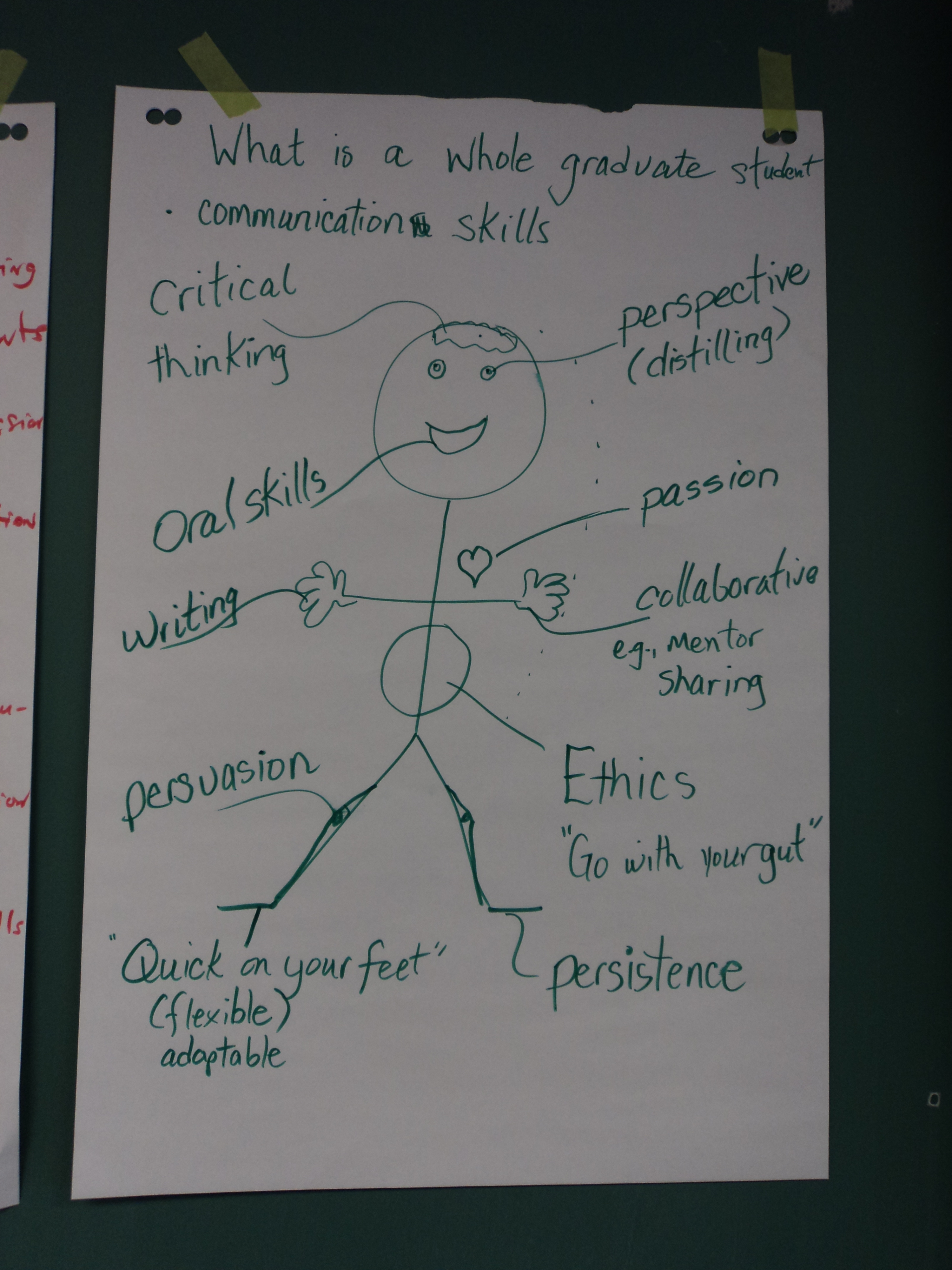
Finally, as I mentioned last week, I was just at a conference on graduate student development. It was a great opportunity to meet with graduate students, graduate administrators, and faculty to discuss ways to support graduate students. In addition to making a presentation on the role of thesis writing in the professional development of graduate students, I was also able to attend some great sessions about other aspects of graduate student development. At one such session, we were asked to define a ‘whole’ graduate student. It was an interesting question; we all know that a graduate student is more than just an intellect, but it was fun to try to identify all the components that make up a rounded and successful graduate student. One of the members of my group had the great idea to draw a figure and then identify the different tasks associated with different parts of the figure. I loved the idea of a fully embodied graduate student, one who has to draw on all of his or her resources—intellectual, emotional, and physical—in order to meet the multifaceted demands of graduate study. Here is the image we came up with:

Photo Credit: Sophia Kapchinsky

You can see a mind for critical thinking; eyes for greater perspective; a mouth for oral presentations; a heart for passionate commitment; one hand for writing and the other for collaborative work and mentoring; a gut for ethical instincts; feet for flexibility (being ‘quick on your feet’) and persistence (being ready to ‘go the distance’); and, my favourite, knees upon which to beg for funding. Thanks to all the members of our group! I wish I had learned all of their names so I could give them full credit here.