
Tag Archives: Graduate students

The Faintest Ink

Every other week, this space is devoted to a discussion of things (articles, news items, or blog posts) that I have recently found interesting. I choose things that are connected—sometimes closely, sometimes only tangentially—to academic writing. Responding to other people’s ideas allows me to clarify my own thoughts and to draw your attention to other approaches to the issues central to this blog.

Most of my links posts come from the range of links that I archive during my daily reading. But this one instead comes from something that came up in class and that was then reinforced by some comments in my Twitter feed. In my thesis writing course, we were recently talking about the perils of not writing ideas down when first they strike. In fact, I was stressing the importance of doing more than just jotting down an idea. In most cases, we need to elaborate on the idea so that it may be useful to us later; that is, we need to explain how that idea might play out or why it might ultimately matter or how it relates to our own work. It can be a pain to stop whatever else we are doing when inspiration strikes, but I have learned that finding an old idea without any elaboration is usually a baffling experience. It seems to be human nature to imagine that our future selves will have tremendous recall especially concerning matters that are clear to our current selves. Do you ever find these sort of cryptic notes in your files? ‘This connects to an earlier idea expressed by the second speaker in the fourth panel: it’s a dichotomy’. I made that up, obviously, but have a look at your own conference notes. Chances are, they are full of obscurity (this?), references requiring context (second speaker? fourth panel?) and words that fail to convey any enduring meaning (dichotomy?). It can be a painful experience to find one of these inexplicable notes. Imagine yourself triumphantly concluding ‘it’s a dichotomy!’ and obviously thinking that this was a valuable insight. And maybe it was, but now you’ll never know.

While I was reflecting on this issue, I saw a tweet from @RohanMaitzen that summed this phenomenon up nicely: “Now, if I could only remember why the word ‘superfluity’ seemed so important to my Eugenides review that I got out of bed to write it down.” She later tweeted that she had remembered the significance of superfluity, so her story has a happy ending. Shortly thereafter, I saw the following tweet from @thesiswhisperer: “I had 3 great ideas for my new workshop ‘If the CV is dead, what should I do?’ but was at gym and didn’t write it down. damn.” (I’m not sure how her story turned out, although I have every confidence that her CV workshop was great.) I even encountered a discussion of this phenomenon on Mad Men. In Season Three, there was an episode called ‘The Color Blue’ in which Paul woke up—hungover and still at the office—remembering that he had had a great idea for a campaign but with no memory of what it had been and, more significantly, with no written notes. Peggy encouraged him to tell Don the truth, and he reluctantly agreed, expecting a full measure of Draper scorn. But Don surprised him: he wasn’t scornful, he was sympathetic. The only explanation for this unexpected burst of human kindness is that even Don Draper understands that ideas get forgotten if they aren’t written down. The Chinese proverb that Paul quotes in despair is the perfect expression of this idea: ‘The faintest ink is better than the best memory.’

So, unless you have been granted a freakishly good memory, make it your basic assumption that you won’t remember later what seems obvious to you now. Write it all down with an eye to your future self: make sure that you note whatever you will need in order to work with this idea in a week or a month or however long it is likely to be before you’ll have a chance to return to this idea.

Finally, some related links. Here is a helpful blog post from The Thesis Whisperer with some guidance on how to use a notebook effectively during your graduate study. The ProfHacker blog recently addressed how to make notes on the go. If you are more likely to take notes on a computer or mobile device, here is an overview of Evernote, also from the ProfHacker blog. And if all else fails, maybe the post-it watch will help you when sudden inspiration strikes.

Links: Feedback for Thesis Writers, Post-Academic Careers, Limitations of Spellcheck

Here is an interesting discussion from Rachel Toor in The Chronicle of Higher Education about the writing feedback that is given to thesis writers. Surprisingly, she is discussing what to think when someone says that you ‘write too well’! Toor addresses two possible meanings of this odd utterance. First, she discusses the idea that good writing is somehow inappropriate and suspect in a dissertation. Second, she considers whether ‘you write too well’ is a sort of code for ‘your ideas aren’t that good’. Needless to say, using the term ‘good writing’ as that sort of backhanded compliment would be an outrageous misuse of the term. Toor sums up what one should do if confronted by this unexpected comment: “… if someone ever tells you that you write too well, ask him for an explanation and be prepared to hear something that will cause you to do more work. If, however, he proceeds to make the case that the language shouldn’t matter in scholarly writing, that clarity isn’t important, that good sentences are a waste of academic time, sue that idiot for scholarly malpractice.”

This recent column, also from The Chronicle of Higher Education, covers familiar ground: the graduate student experience. Between the article itself and the vigorous comment stream, the pertinent issues—micro and macro—are well covered. I kept the link but thought it unlikely that I would include it here—what else is there to add? But then I saw this related but very different post from the ProfHacker blog on post-academic careers; the post highlights the value of a good understanding of our professional options and our own vocational inclinations. My question, after reading these two articles, is how the narrative of graduate student misery affects the development of such awareness. It seems possible that the general and accepted level of unhappiness about graduate school may serve to obscure specific unhappiness. If all graduate students are miserable and expected to be so, how does any individual graduate student learn that he or she might just not like this type of work? Similarly, it can be hard to interpret the pleasure derived from non-academic work when such work is often framed as nothing more than an illegitimate way of avoiding the legitimate tasks of academic work.

Lastly, here is something fun on the limitations of spellcheck programs. You’ve probably read or seen something like this before, but Taylor Mali’s enthusiastic wordplay (and occasional profanity) is sure to focus your attention on what your spellchecker might be missing.

Links: Academic Blogging

First, before I forget: National Punctuation Day is coming up on Saturday. I confess, I was initially confused by this announcement because I was sure I had already mentioned this on the blog (and this blog didn’t exist last September). But I soon realized that I was confusing National Punctuation Day with National Grammar Day. Two totally different days. This blog probably isn’t the place to discuss how funny the ‘National [fill in the blank] Day’ phenomenon is, but I can’t resist. August 15th, for instance, is both National Relaxation Day and National Failure Day, a combination that sounds weird but actually makes sense in a mean, puritanical sort of way. It is also National Lemon Meringue Pie Day. Again, there is a certain logic: if you’ve ever made such a pie, you probably needed to relax afterwards and you may very well have failed. Here is a list of more of these special days (I was tired after reading just the month of January) and some discussion of the procedure for getting such a day recognized (just kidding, there is absolutely no procedure). But even though there are national days of many inconsequential things, this does not lessen the importance—the 365-days-a-year importance—of punctuation. I urge you to click here to learn more about its special day.

Now, on to today’s post. Since I have encountered a range of thought-provoking blogposts on academic blogging recently, I thought I would devote this post to that topic.

Here is a blogpost on the darker side of blogging by Jeffrey Cohen from the In the Middle blog. Cohen reflects on the challenges of maintaining an online presence; in particular, he does a good job articulating some of the hazards that arise when exposure exceeds accountability. Ultimately, he intends to continue to engage social media as part of his academic life, but he is clearly concerned that online negativity could eventually overwhelm the tremendous promise of online communities.

Here is a discussion in The Scholarly Kitchen on the state of blogging and how it is perceived. In this post, Kent Anderson discusses the lack of respect accorded to blogging. He provides a vigorous defense, concluding that the purported weaknesses of blogging may actually be strengths: “Like many disruptive technologies, a blog’s ‘weaknesses’—the quick-hit writing with links substituting for wordiness, the ability to generate content quickly, the ability to interact with an audience, the ability to write long or short, the embedded ability to link to and host multimedia, the participation of unexpected experts—are really its strengths.”

Finally, here is something on blogging from The Thesis Whisperer in which a guest author, Andy Coverdale, talks directly about the role of blogging in the life of a PhD student. In particular, Coverdale considers how blogging affects both his writing process and the potential professional reception of his work. This post is essential reading for any graduate students trying to evaluate the benefits and complications of adding blogging into their professional lives.

P.S. I just learned that today is National Pecan Cookie Day. Do with that information what you will—I know what I’m going to do!

Writing for a Presentation

Regular readers of this blog know that it has an unsurprising tendency to reflect my current teaching or research interests. So today, after my first week of teaching, you will have to bear with me while I reflect on writing for oral presentations. This post is about the aspect of writing that is currently most on my mind: the creation of a written text designed to be read aloud. Even if oral presentations aren’t your favourite thing to think about (and most people like presenting even less than they like writing), they are an area in which most of us can improve. In fact, oral presentations are a topic that most people choose not to think about too much. Instead, most people just try to survive them. And most of us know firsthand what it is like to sit through a presentation when the presenter has no higher ambition than to survive. The challenge of oral presentations is obvious: oral presentations are a complex blend of intellectual command, organizational skills, technological expertise, and performance ability. So there is a lot to be said, but today—since this is still a blog about academic writing—I will focus on the creation of a text written explicitly for a presentation.

I will begin with an important clarification. Writing a text that is designed to be read isn’t something that all of you will do. In many fields, the expectation will be a presentation that revolves around speaking and not reading. But those of you who do need to read a presentation have a uniquely difficult task. Faced with this task, some presenters seem to feel that reading is in fact all that is required. However, the experience of having a standard academic paper read to us is not one that most of us wish to repeat. There is, of course, a range in people’s listening abilities; some listeners can manage a degree of attention and comprehension that others—me, for instance—cannot. But as a presenter, it is probably best to target average listeners, rather than the superstars of academic listening. And the average listener has needs that reading alone can’t meet.

So once you’ve learned that a read presentation is standard in your field and acknowledged that simply reading a paper may fail to engage your audience, what to do? The key is to identify what is so valuable about the read presentation. A read paper allows for a complexity and density that might not be achieved without a written text. The benefit of reading is that you can offer deliberately structured prose of the sort that most of us can’t create on the fly. This is what you will be able to maintain in your written paper: sophisticated sentences that convey complex relationships among concepts. Beyond that, you need to think how your presentation text needs to be different. Here are three key areas for alteration: one, the degree of elaboration; two, the extent of structural explanation; and, three, the use of actual annotations of your presentation text.

In the first place, your complex sentences will need elaboration; what can be said once for a reader should be reiterated for a listener. Complex ideas will likely need to be unpacked further in the designed-to-be-read version. Ask yourself if a sentence in your writing might require a reader to read it more than once or even just pause to think about it. If so, you must work that repetition or time for reflection into your read version; strategic repetition is your friend here. I don’t know about you, but I don’t see a lot of presentations during which I wished that the speaker had spent less time clarifying the key idea.

Second, you need to think of your paper as a one-way street for the listener. When readers read you, they have the luxury of flipping back to something, of reminding themselves of where they are within your argument. Listeners, on the other hand, are completely at your mercy. Once they lose the thread, their only way to regain it is through the structural signposts you have provided.

Third, the physical text that you read from needs to be distinctly different from a normal paper. The difference will come through the annotations that you make to direct your reading process. Some sentences need to be read in their entirety; some sentences can be a way to get you started with some room for improvisation at the end; some aspects of your paper should probably be left completely unwritten. I usually suggest that some proportion of the examples or anecdotes or elaborations be left open. I also suggest noting for yourself basic things like where you will pause, where you will look up, where you will put the emphasis. If you don’t need this degree of guidance, you will naturally disregard it, but many will find it helpful. For most of us, the appearance of spontaneity is much better than actual spontaneity.

One final note: a more dynamic read presentation requires careful attention to time management. When practicing ‘reading’ in this way, you have to make sure you know how long everything will take you during the actual presentation. It can be helpful to know whether it generally takes you longer to give a presentation than you anticipate or whether you are one of a smaller number of people who actually end up being quicker during the real thing. If you are in the former group, time yourself approximating the presentation as closely as possible, and then give yourself a few minutes leeway. If you are in the latter group, try slowing down!

This topic was well handled by ProfHacker last winter. Their blogger talks about creating a dedicated reading copy, a term which does a good job conveying how it must be different from the original version of the paper. If you have other questions about oral presentations, here are a few recent links that might prove helpful or might lead you to other helpful resources. Here is something from Dave Paradi’s blog about a technical issue: preparing to make a presentation on a computer that is not your own. Here is something from the Presentation Advisors blog on simple ways a presentation can go wrong. Here is something from The Guardian on deciding strategically how many conferences to attend. Finally, here is something from The Professor is In blog on making conferences work for you as a graduate student or junior academic.

Links: Drafts and Formatting, Teaching and Productivity, Writing and Relativism

Here is something from the new Lingua Franca blog at The Chronicle of Higher Education on excessive formatting in manuscripts. The author, a senior editor at the University of Chicago Press, is making an important point about manuscripts: editors don’t want complex formatting. All that formatting just has to be stripped out, a process which is time-consuming and which can, potentially, lead to inadvertent changes to the material. As a writing instructor, my interest—as I have mentioned before—is keeping drafts free of fancy formatting and thus keeping them easy to revise. As I write this, I realize that enthusiastic formatting may be more than just a random phenomenon, at least in my writing process. I’m pretty sure I turn to formatting for comfort when writing is going badly; the less confidence I have in what I am writing, the more likely I am to start messing around with fonts and footers and subheads. That way, even if my work sounds terrible, at least it will look like a real paper. Needless to say, this is a counterproductive strategy. Not only does the premature formatting add nothing, it may well act as an impediment to digging into a draft and making substantive changes.

Here is a report from Newswise on some new research on STEM students who supplement research with teaching. The research suggests that time spent teaching may actually improve students’ abilities “to generate testable hypotheses and design experiments around those hypotheses”. The researchers suggest that this improvement may simply come from the process of explaining complex issues to students and from having to look at research problems from multiple perspectives. The findings make intuitive sense, so it is interesting that teaching and other activities are so often seen as distractions for graduate students rather than as valuable professional development.

Finally, here are some remarks from William Zinsser on the cultural dimensions of learning to write in English. His audience is journalism students, but the ideas may also be of interest to academic writers more generally. Most multilingual graduate students will benefit from having a good working understanding of how academic writing in English may differ from academic writing in their other language(s). Of course, no writing teacher will want to reify the cultural differences in academic writing. But students themselves—through alert reading and sensitive comparisons—can come to a valuable understanding of different practices of academic writing. I think that some relativism about ‘good academic writing’ is of value to students who may otherwise feel that there are universal standards of academic writing that are simply oblique to them.

Links: Rules for Writing, Strategies for Scientific Writing, Excuses for Plagiarism

Here is something from the Huffington Post on the difficulty of finding workable ‘rules’ for good writing. Robert Lane Greene provides a useful breakdown of types of rules for writing: rules that everyone knows; standard but tricky rules; obsolescent rules; disputed rules; non-rules; formality differences; regional differences; dialect differences; house style; and personal taste.  His use of these ten different categories shows how difficult it is to rely on simple notions of right and wrong in our writing.

Here is something from Inside Higher Ed on writing for science graduate students. In this piece, Stephen C. Stearns, a senior scientist at Yale, offers his own take on proposal writing, thesis writing, and publishing.

Finally, here is something amusing from The Monkey Cage blog: a top ten list of excuses for inexcusable plagiarism. If you missed the reference to Clippy, count your blessings.

Links: Why We Write, Peer Editing, Names and Titles

In this Academic Minute podcast, Dana Washington of Lock Haven University discusses why we write. She is speaking about writing broadly as self-expression, but I think her remarks also have relevance for academic writers. Admittedly, academic writers do write to fulfill various requirements and obligations, and we often do so under complicated pressures of both time and expectations. Despite these hindrances, however, we can still try to view the writing task as a valuable opportunity to share the research and reflections that inform our intellectual lives.

This article from the National Post has very little to do with academic writing, but I loved this quote  from Iain Reid about sharing our draft writing: “I rarely ask friends to read a work in progress. It’s a frustrating affair. My friends are busy. They have other things to read, interesting and funny things, things online or things that already have a title, spine and are bound; not disorganized sentences that are only partially formed. On the rare occasion it does happen, the results are frustrating, too. I don’t actually want to discuss it. I’m not actually hoping for constructive criticism. Just ignore the spelling mistakes, discount the preachy and rambly parts and just tell me how it’s borderline genius.” That basic asymmetry–I give you my writing asking for criticism but hoping for praise–presumably derails a lot of potentially valuable peer editing.

Finally, here is some practical advice from Inside Higher Ed on the use of titles when addressing faculty. And here is a related blog post from Hook and Eye by an instructor who will answer to anything. I too will answer to anything, but my preference is definitely for students to call me by my first name. The formality of titles may have value in some settings, but I feel it adds nothing to my teaching situation. In fact, the relative informality of using first names emphasizes, I hope, the way academic writing is an ongoing challenge that my students and I need to tackle together.

Blogging as an Academic Activity

In my last post, I mentioned that I was taking a week off from this blog to attend a conference at which I would be making a presentation about this blog. Since I have been so preoccupied with thinking about blogging, I thought I would devote today’s post to a consideration of how blogging relates to other academic activities.

Five months into this blogging adventure, I realize that it is premature to draw any definitive conclusions. But having to make a presentation on this topic forced me to come up with some provisional conclusions about the difference between blogging and other academic pursuits. Here are four themes that seem to characterize the singularity of the blogging experience:

  1. The blog allows me to craft my ideas into a form that endures outside of a particular class setting (blogging as permanent).
  2. The blog allows me to reach a broad number of people with whom I might otherwise have no connection (blogging as public).
  3. The blog allows me to share my thoughts in short bits at frequent intervals (blogging as periodic).
  4. The blog allows me to express my ideas in whatever way I choose without going through anyone else’s editorial process (blogging as personal).

Looking at these four themes together, I think it is possible to think of academic blogging as the creation of a hybrid space that combines aspects of traditional publishing (because it is permanent and public) and aspects of teaching (because it is periodic and personal). This hybrid space seems to be well suited to meeting the needs of graduate students who want to improve their academic writing skills: because it is public, a blog can be accessed whenever readers need it; because it is periodic, a blog can provide readers with information in manageable bits; because it is permanent, a blog can give readers the opportunity to pursue an issue further through earlier posts on related topics; and, finally, because it is personal, a blog can adopt a clear authorial stance that allows readers to determine whether it suits their writing needs.

The conference itself was great. Thanks to all CASDW members for an interesting and congenial weekend in Fredericton!

Links: Supporting Scientific Innovation, Libraries and Abundance, Writing to Your Dissertation

Explorations of Style will be taking next week off; I have to travel for a conference and, first, to make that travel worthwhile, have to write the paper I will be presenting at the conference. The presentation is on the role this blog plays in my classroom teaching, so don’t imagine the lack of posts means I’m not still thinking about the blog all the time. I will return with something new—or at least something adapted from my presentation on blogging and teaching—on June 1st. See you then! I will leave you with a few weekly links.

Here is a great piece from Slate on the best model for funding innovative scientific work. Tim Harford offers a fascinating discussion of the relationship between funding—both public and private—and scientific progress.

While I don’t know much about libraries, I am sure that those of us who benefit from university libraries ought to listen to what librarians have to say about the sustainability of the current model of managing collections. Here is something from Barbara Fister, writing at Inside Higher Ed. I particularly like the way she uses a food analogy, stressing the need to think about sustainability even in the face of apparent abundance.

Finally, from McSweeney’s, here is someone’s letter to his dissertation. This letter is part of their series of ‘Open letters to people or entities who are unlikely to respond’. I am obliged, of course, to say that you would be better off writing your dissertation than writing to your dissertation. But I found this line funny: “You probably sense that I am a little frustrated, the way that I spend time with you every day but it’s never quality time, the way you are always on my mind but we never seem to get anywhere.” (Thanks to The Thesis Whisperer for the link.) If you spend any time with your thesis over the weekend, I hope it is quality time.

Links: Communicating Research, Understanding Procrastination, Drawing Pictures

From Inside Higher Ed, here is something on explaining doctoral research in general terms. It is easy to see why the PR department of a university might be interested in having doctoral students or recent graduates who can comment cogently on their work for a general audience. But I think this ability can also be great for you as a writer. In the first place, being able to give a ready account of your work will boost your confidence; it never feels good to stumble over an explanation of the project to which you have devoted your whole life. And the clarity and simplicity that you achieve when you encapsulate your research will always help you to understand it better.

Also from Inside Higher Ed, here is something on procrastination. This article reviews a new book by Piers Steel, The Procrastination Equation: How to Stop Putting Things Off and Start Getting Stuff Done. I particularly liked how the article referred to Steel as a ‘procrastination expert’; I am pretty sure we all think of ourselves as procrastination experts! The point that jumped out at me in the interview with Steel was his comment on procrastination among people who are ABD: “Doing any major task for the first time is extremely hard motivationally as you don’t have a firm mental image of what you are supposed to be doing.” It’s a simple point, but still a profound one. Not being able to see the full trajectory of the project can leave us uncertain and thus prone to procrastination.

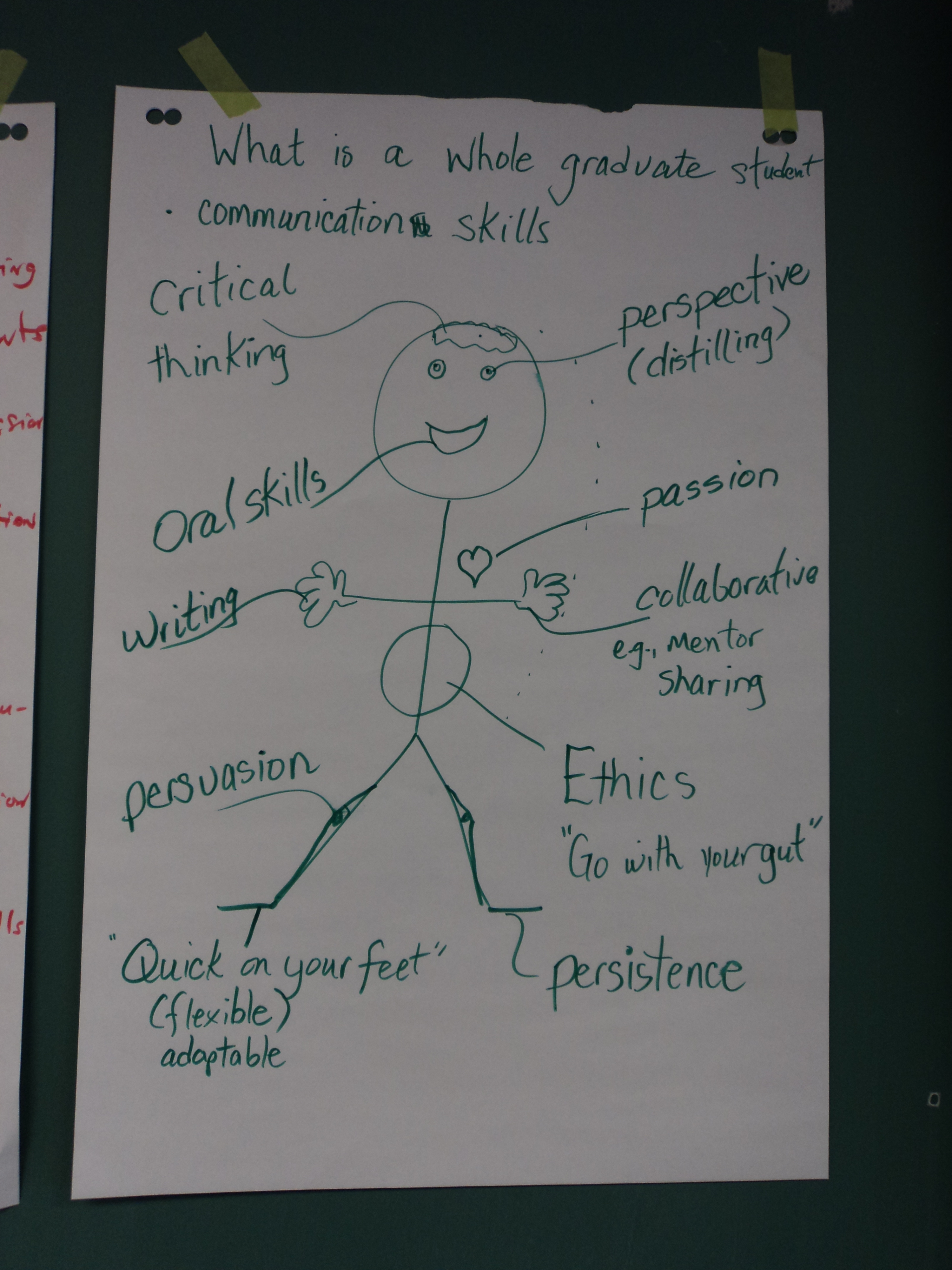
Finally, as I mentioned last week, I was just at a conference on graduate student development. It was a great opportunity to meet with graduate students, graduate administrators, and faculty to discuss ways to support graduate students. In addition to making a presentation on the role of thesis writing in the professional development of graduate students, I was also able to attend some great sessions about other aspects of graduate student development. At one such session, we were asked to define a ‘whole’ graduate student. It was an interesting question; we all know that a graduate student is more than just an intellect, but it was fun to try to identify all the components that make up a rounded and successful graduate student. One of the members of my group had the great idea to draw a figure and then identify the different tasks associated with different parts of the figure. I loved the idea of a fully embodied graduate student, one who has to draw on all of his or her resources—intellectual, emotional, and physical—in order to meet the multifaceted demands of graduate study. Here is the image we came up with:

Photo Credit: Sophia Kapchinsky

You can see a mind for critical thinking; eyes for greater perspective; a mouth for oral presentations; a heart for passionate commitment; one hand for writing and the other for collaborative work and mentoring; a gut for ethical instincts; feet for flexibility (being ‘quick on your feet’) and persistence (being ready to ‘go the distance’); and, my favourite, knees upon which to beg for funding. Thanks to all the members of our group! I wish I had learned all of their names so I could give them full credit here.