Category Archives: Graduate Writing

Posts that discuss topics of particular interest to graduate writers

Conservatism of Expectations

If you’re a regular reader of this blog, you will know that I’ve spent the last few years working on a book about graduate writing. That process is now drawing to a close: Thriving as a Graduate Writer will be published in June! Between now and then, I’m going to use this space to share brief excerpts. In addition to my discussion of principles, strategies, and habits for effective academic writing, the book has short ‘asides’ that allowed me to engage with topics outside that main narrative. Over the next four months, I’ll share my favourites of those asides. As always, I’d love to hear what you think!

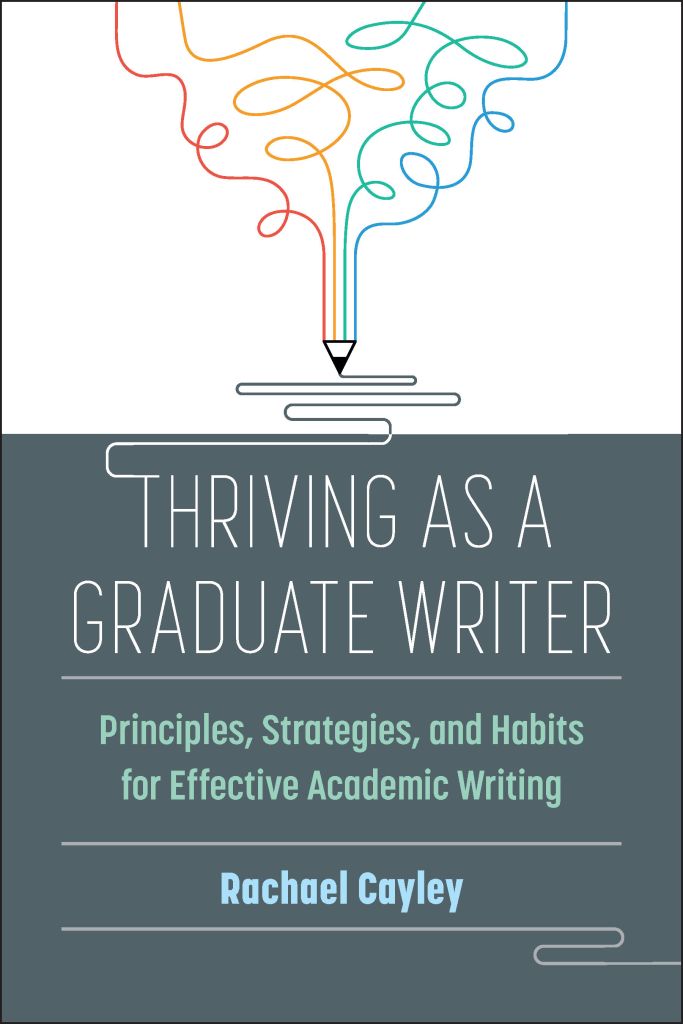
Book Cover showing title: Thriving as a Graduate Writer

Conservatism of Expectations

It’s hard to talk about meeting reader expectations as a graduate writer without attending to the conservative implications of prioritizing established expectations. Rather than conform to expectations that feel allied to outdated and inequitable systems, some graduate writers may wish to write differently, in ways that confront or subvert the norms of standard research communication. Resisting those expectations can take many forms: normalizing World Englishes; refusing white supremacy in language; understanding subjectivity in research imagination; drawing upon Indigenous research epistemologies; integrating multimodal research into doctoral theses. Any one of those endeavors could easily be hampered by the replicative nature of doctoral education. And writing in a manner that requires adherence to existing academic practices can be demoralizing; making changes to those practices is central to why some people undertake graduate work. As a result, some writers may choose to discount those norms during graduate work. It’s worth noting that some writers may share those critical commitments while being uninterested in challenging existing norms. Despite wishing change to happen, these writers may feel that their academic work is already unfairly scrutinized or that it isn’t their job to transform academic writing practices. What’s more, some writers in this situation may feel particularly anxious to gain access to a hidden curriculum that others seem to assimilate more easily. Given that range of attitudes and pressures, I think there is value in laying out established conventions in a way that leaves the writer the freedom to choose their own path. Certainly, working around norms—or making norms work for you—is easiest when those norms are well understood. I don’t want the ideas contained within this book to be an impediment to writing in ways that support the work that feels urgent to you; instead, I hope they can be deployed in the service of the academic work that you want to do in the way you want to do it.


Thriving as a Graduate Writer will be available in early June from the University of Michigan Press. To pre-order your copy, visit the book page. Order online and save 30% with discount code UMS23!

Nobody’s First Language

If you’re a regular reader of this blog, you will know that I’ve spent the last few years working on a book about graduate writing. That process is now drawing to a close: Thriving as a Graduate Writer will be published in June! Between now and then, I’m going to use this space to share brief excerpts. In addition to my discussion of principles, strategies, and habits for effective academic writing, the book has short ‘asides’ that allowed me to engage with topics outside that main narrative. Over the next four months, I’ll share my favourites of those asides. As always, I’d love to hear what you think!

Book Cover showing title: Thriving as a Graduate Writer

Nobody’s First Language

If you’ve had any graduate writing support, you may have heard a version of this saying: “Academic writing is nobody’s first language.” This sentiment is generally used in a manner that is meant to be empowering. If you are a multilingual graduate writer, it tells you that everyone struggles with academic writing. If you are writing in your first language, it tells you that your struggles with graduate writing are still legitimate. In short, since academic writing isn’t simply about language, linguistic status shouldn’t be seen as the determining factor in your ability to thrive in this area. While this principle seems accurate, it shouldn’t be used to suggest that every novice academic writer is in the same boat. Any such flattening of different experiences of academic writing acquisition risks diminishing the challenge of learning to communicate a complex research agenda in a subsequent language. And it also risks minimizing the implications of social capital for academic writing acquisition. The original quote from which this saying derives makes this nuance clear: “Academic language is a dead language for the great majority of French people, and is no one’s mother tongue, not even that of children of the cultivated classes. As such, it is very unequally distant from the language actually spoken by the different social classes. To decline to offer a rational pedagogy is, in this context, to declare that all students are equal in respect of the demands made by academic language…” (Bourdieu and Passeron 1997, 67). Acknowledging this “unequal distance” is crucial. Academic writing may be nobody’s first language, but some graduate writers will have more familiarity with and access to academic modes of expression. As such, each graduate writer will need to expend a particular amount of emotional and cognitive labor to develop their academic writing fluency. (I’m grateful to Alex Ding for providing the actual quote underlying this saying and for his insightful discussion of the broader implications surrounding this issue.)


Thriving as a Graduate Writer will be available in early June from the University of Michigan Press. To pre-order your copy, visit the book page. Order online and save 30% with discount code UMS23!

Advice Translator

If you’re a regular reader of this blog, you will know that I’ve spent the last few years working on a book about graduate writing. That process is now drawing to a close: Thriving as a Graduate Writer will be published in June! Between now and then, I’m going to use this space to share brief excerpts. In addition to my discussion of principles, strategies, and habits for effective academic writing, the book has short ‘asides’ that allowed me to engage with topics outside that main narrative. Over the next four months, I’ll share my favourites of those asides. As always, I’d love to hear what you think!

Book Cover showing title: Thriving as a Graduate Writer

Advice Translator

Since graduate students are so often on the receiving end of advice, some of you might find it helpful to be able to engage in a quick translation process.

Advice: You should do X. 

The person telling you to do X is probably suggesting a way to achieve something (let’s call it Y). Unfortunately, they aren’t talking about the importance of Y or telling you how you might achieve Y; they are just telling you to do X. If all you do is attempt X, without understanding its connection to Y, you might actually make your situation worse. A little further investigation on your part can help translate the advice into something more helpful: 

Translation: You should do X because Y

Once you have that formulation, to can adapt the advice to your own purposes:

Advice you can use: You should do something to achieve Y. 

To make this more concrete, let’s consider a perennial favourite bit of writing advice: 

Advice: You should write in the morning.

This advice is fine if you are a morning person; however, if you are not, you may end up struggling to force yourself to write according to someone else’s temperament. Or maybe you are a morning person, but your life circumstances–the demands of paid work or care work–prevent you from using that time for writing. To avoid the frustration of advice that doesn’t work for you or your life, you can try to understand the underlying reason for the advice: 

Translation: You should write in the morning to avoid wasting your best energy of the day.

Advice you can use: You should find ways to avoid wasting your best energy of the day.

Now the ball’s in your court. You need to identify when you have the most energy and find ways–within the context of your life–to preserve that time for writing. This translation technique has the potential to help you to use supervisory advice, especially when you find it overly attuned to the specificity of someone else’s writing situation. The cliché that all advice is a form of nostalgia can be true. But it’s possible to translate such advice into a more suitable form, thereby deriving the benefit of advice in a way that makes sense in your writing life.


Thriving as a Graduate Writer will be available in early June from the University of Michigan Press. To pre-order your copy, visit the book page. Order online and save 30% with discount code UMS23!

Display Work

If you’re a regular reader of this blog, you will know that I’ve spent the last few years working on a book about graduate writing. That process is now drawing to a close: Thriving as a Graduate Writer will be published in June! Between now and then, I’m going to use this space to share brief excerpts. In addition to my discussion of principles, strategies, and habits for effective academic writing, the book has short ‘asides’ that allowed me to engage with topics outside that main narrative. Over the next four months, I’ll share my favourites of those asides. As always, I’d love to hear what you think!

Book Cover showing title: Thriving as a Graduate Writer

Display Work

A persistent challenge in graduate writing is the demand of what I call ‘display work’: explaining things that the typical reader already knows in order that they will recognize you as a fellow-knower of those things. A certain portion of graduate communication involves relaying information in a manner that is performative rather than purely communicative. This activity is an unusual reconfiguration of normal communication in which you tell people things precisely because they don’t already know them. This performative feature of academic writing can be puzzling and painful to the novice writer. I am frequently asked a version of this question: ‘How much should I say here, when my reader already knows all of this?’ Since this display work is generally obligatory, it’s a good idea to recognize the tension and learn to work with it. During graduate coursework, it can be helpful to think of the audience as someone who has finished the relevant course or program; you won’t have to explain everything, but you will have to cover lots of ground that you may worry will be overly familiar to your actual reader. During thesis writing, the tension becomes more challenging; a thesis is a blend of display work (extensive literature review, expansive methods, comprehensive research results) and the crucial communicative work of conveying your own research contribution. Being aware of the imperatives of both elements of graduate writing can help with establishing the right balance, one that displays your disciplinary competence while also communicating the novelty of your research.


Thriving as a Graduate Writer will be available in early June from the University of Michigan Press. To pre-order your copy, visit the book page. Order online and save 30% with discount code UMS23!

Unpacking Professional Development for Graduate Students

The work that I do on this blog is generally designed to support my work in the classroom, which involves teaching academic writing and speaking to graduate students. When graduate students attend these sorts of workshops or courses, this undertaking is often characterized as professional development. In order to understand that characterization, it’s essential to think about what is meant by the term ‘professional development’. Most of us first became familiar with the term as something designed for already-working people. That is, professional development was necessary precisely because the original training or education was complete. After a number of years in a job, we benefit from professional development because it can offer us innovative ways of approaching what we do, thus making us more confident, competent, or engaged. When we start thinking of professional development for graduate students—that is, for people who are currently in school learning how to do something—we have to confront an obvious question: Why do we need ‘professional development’ for people who are still in school? Isn’t that what the school is for? If we are to offer professional development for graduate students, we clearly have to be reflective about the process.

Whether or not professional development initiatives act as an implicit rebuke of existing graduate education, the growth of such initiatives highlights what generally isn’t happening within graduate programs. Traditionally, graduate programs have been good at training students to do a certain sort of academic work, but less good at supporting a wider range of ancillary skills. Before looking at these ancillary professional skills in more detail, I’d like to make a distinction between professional development and professionalization. My anecdotal sense from my own university is that professional development tends to be offered centrally while professionalization initiatives are coming out of departments themselves. While the two things are similar, they are also significantly different. Professionalization is something that happens to the field of study whereas professional development is something undertaken by the individual. That is, professionalization reflects an awareness that graduate departments themselves have an obligation to offer initiatives—that are often part of a degree program and possibly even compulsory—to support students’ eventual ability to thrive professionally. In contrast, professional development has an individual dynamic: the student can decide to develop their professional skills on their own time and away from the department. While I think the structural integration of professionalization is valuable for a range of reasons, I’m going to focus in this post on the training offered centrally under the auspices of professional development. In what follows, I am going to divide these skills in three categories: integral; professional academic; and professional non-academic.

Integral skills are those that allow us to communicate our research effectively. The ability to explain research to a wide range of audiences in a wide range of formats must be seen as integral to the educational goals of a graduate student: research that can’t be conveyed to others in an appropriate fashion is inherently lacking. These integral skills—writing effectively, understanding how to make presentations, being able to communicate research to different audiences—will indubitably help students in their professional lives, but they are different from other forms of professional development because of their inherent connection to being a successful student. You can’t thrive as a graduate student without developing these skills, which makes them different from the skills necessary for moving from being a student to being a professional.

Professional academic skills are those that prepare students first for the academic job market and then for an academic job. The key element here is, of course, teaching; as so many have observed, a PhD is often expected to prepare us for teaching despite the fact that the actual teacher training component of doctoral education can be pretty hit and miss. Supporting graduate students as nascent teachers rather than just fostering their research skills is a crucial way to prepare them for academic jobs. Similarly, talking about how to apply for funding and how to prepare for scholarly publishing can help with the transition from student to professor. However, given the current state of the job market, preparing for the job of being an academic isn’t sufficient; graduate students also need to be prepared for the travails of an increasingly fraught job search process.

Lastly, professional non-academic skills are those that bridge the gap between graduate training and the jobs that many graduate students are going to find—by choice or by necessity—outside of the traditional professorial role. We know that doctoral training is often extremely transferable, but we need to clarify those pathways and facilitate the translation that allows graduate students to frame their existing skills as valuable for a wider range of professional opportunities.

These three species of professional development obviously involve a great deal of overlap. Some of the skills will operate in all three areas because they are fundamental skills. Some of the skills will be readily transferable: a good understanding of oral presentation skills, for instance, will allow us to make many different sorts of effective presentations. And some of these skills themselves will assist students in understanding the very nature of transferable skills. As an example, when I teach students about writing for different audiences, they are learning two things: at a basic level, they are learning to adjust their writing to suit its potential audience; at a higher level, they are also potentially learning to be more reflective about the nature of the skills that they are developing in graduate school.

Accompanying all these species of professional development, of course, is the need to provide holistic support for graduate students. Supporting graduate students means acknowledging both that they have issues—financial, familial, medical, emotional—affecting their graduate experience and that the task of building the necessary research and ancillary skills is inherently difficult. We need to give graduate students access to the skills they may lack while also acknowledging the complex stress of graduate study. While it doesn’t replace providing concrete emotional support for graduate students, providing these three types of ancillary skills can have the effect of normalizing their challenges. Graduate students, who so often struggle in their dual role as advanced student and novice scholar, can be reassured by the very existence of this sort of professional development. I’m often surprised by the fact that a frank discussion of the intellectual and emotional challenges of graduate writing is met by relief from many graduate students. Despite the prevalence of that narrative, many graduate students have often internalized a different and more damaging narrative about their own deficiency vis-à-vis the expected work of a graduate student. These psychological costs have tangible implications for the students themselves and also play an important role in rates of attrition and lengthy time-to-completion.

As we think about these three species of professional development and the complex demands of graduate study, we also need to think about the diverse needs of different graduate student constituencies. We can divide graduate students by discipline; this division can be a broad one between the sciences and the humanities or something finer that recognizes the unique professional demands of different graduate programs. We can divide graduate students by linguistic background; some students are learning to write suitable academic prose in their first language while others are accomplishing the same task in a subsequent language. We can divide students by degree; the needs of doctoral students are often different from those of Master’s students, especially from those in terminal Master’s degrees. In order to tackle needs spread along so many different spectrums, it is very helpful to have a deeper understanding of the types of things we are trying to impart. Clarifying our understanding of what professional development might mean for graduate students can help us to design suitable offerings and explain those offerings in terms that make sense to the many constituencies involved. In the end, offering these professional skills is one way of ensuring that all graduate students—each of whom represents a unique spot among many overlapping measures of identity—can have the chance to thrive in graduate school and beyond.

I would like to thank Dr. Jane Freeman for helpful comments on an earlier draft of this post.

The Writing on the Slides

A few weeks ago, Raul Pacheco-Vega asked on Twitter whether presentation slides were a form of academic writing. My first thought was ‘sure, why not?’; I see little point in circumscribing the activity of academic writing to exclude any of the things that academics write. But my second thought was that conceiving of slide preparation as academic writing could easily contribute to the notion that slides are places for extensive text. This is not to say that slide writing couldn’t be a genre of academic writing, as Pat Thomson suggested in her reply to Raul, but rather that emphasizing writing on slides may lead us to over-emphasize the extent to which slides are meant to be read.

Of course, some slides are meant to be read; in some contexts, slides are a way of sharing content. Some people—especially in business environments—use slides as a kind of report, as a platform for conveying information that will need to stand alone. That use of slides will, needless to say, require a very different type of writing; this helpful post from Dave Paradi explores the difference between presentation slides and slides designed to stand alone. (Teaching slides, which often try to both stand alone and support a lecture, are another matter altogether.)

What interests me here, however, are those slides that are meant to support a formal talk. In my view, only once that talk has been written—ideally in a manner suitable to being spoken—ought the accompanying slides be designed. I’m not making a capital-D distinction between designing and writing, but rather making a practical point. Presentation software should not have the same relationship to a presentation as word processing software has to a written text. We often start writing a paper by opening our word processing program and beginning to type; unfortunately, people often start working on a presentation by opening up their slide software and beginning to type. The creation of slides in advance of the writing of a presentation has two hazards. First, the slides are being created before we have a fully worked out plan, which means that they may not represent the optimal arrangement of information. Second, these premature slides are almost always wordy because they are bearing the brunt of the initial rush of thinking.

In this scenario, the presenter is saddled from early on with slides that lack coherence and that have too many words. As the presenter then tries to shape the oral presentation, those slides can be a bad influence. Speakers often seem to be reacting to slides rather than using them as support for their remarks. And when the speaker is reacting to a slide, the audience will often struggle to decide how to allocate their attention. A speaker should always be in control of the audience’s attention, including their attention to the slides. When the slides are too wordy, the audience will often be tempted to read those slides, thus neglecting the words being delivered by the speaker. Once the audience’s attention is bifurcated in that way, it can be hard for the presentation to succeed. If, on the other hand, we write a presentation before we design the slides, we are more likely to create slides that enrich the presentation by providing synchronized visual support.

This reflection has taken me far from Raul’s original question and deep into one of my own preoccupations. Again, it is not that I have any interest in defining what is and is not academic writing. But I do think it’s valuable to frame presentation writing as something distinct from the process of slide design. If it suits your workflow or your philosophy of work to define both as falling under a broad #acwri umbrella, that’s great. The crucial issue for me is that we subdivide the activity of presentation preparation into the work of writing what we are going to say and the subsequent planning of what the audience will see on the screen.

Moving from Problem to Response

Earlier this year, I had a post on the basic structure of an introduction, using a concept derived from Swales and terminology derived from Booth, Colomb, and Williams. In a subsequent post, I went on to talk about how to use this model to craft an effective thesis introduction. In both posts, I stressed the great importance of explaining the significance of addressing the problem before turning to the response. But I realized later that I’d neglected to talk about a related issue that often arises in an introduction: How do we move from problem to response? 

In some cases, the progression from problem to response can be quite simple: a general context naturally narrows to a specific problem, creating space for a particular response. In these cases, the general topic tends to be well understood, leaving a narrow area still to be grappled with. Usually, when a writer gets to this point, the transition to the response is made quite easily. However, there are other cases in which the problem is broad, making the transition to a narrow response more difficult. Since most research projects benefit from a narrow focus, it is essential that we understand how to move between a broad problem and a narrow response.

In these cases, the general context doesn’t naturally narrow to a specific problem. Instead, the context leads to a broad problem: “However, we don’t know enough about X”, where X is a broad area that hasn’t yet been satisfactorily investigated. It is crucial for a writer in this situation to recognize that the thesis itself won’t be able to address that broad area. What the thesis will be able to do, however, is to use an example of X to begin to develop our understanding of X as a whole. To be clear, there is always a specific problem, but in some cases that specific problem is simply being used as a way of getting at the broader problem. Perhaps we don’t, for instance, understand how any compound works under some particular circumstance; the thesis won’t look, of course, at all compounds: it will look at an exemplary compound. Similarly, maybe we have identified a broad phenomenon that has been under-examined, so we look at a particular text or use a case study to ground the inquiry. However, in these cases, when the specific response doesn’t just flow from the problem, writers sometimes falter.

What is needed is an explanation of how the narrow response is a useful way of getting at the broad problem. This task isn’t particularly difficult but is often neglected. There’s no one particular route that must be taken: the essential thing is that the reader is given a bridge. Otherwise, the reader will encounter a broad statement that not enough is known about X, followed by a very precise statement of what the current research will undertake to do. Just as the reader needs to know why addressing a particular problem is significant, they also need to know how the response serves to address the problem. In those cases in which that transition isn’t obvious, the writer must fill in that space. Needless to say, the key issue will be justifying why this particular response—why this compound, why this text, why this case study—can be used as an entry point into the broader problem.

In general, I recommend that all thesis writers pause before elaborating the specifics of their research project. Writers often feel more comfortable in the realm of the response; the task of providing a specific description of what the research will actually do can feel like a bit of terra firma. Unfortunately, out of a desire to reach that shore, writers often rush though necessary and important transitions between problem and response. Pausing at that point can help remind the writer of their obligations to help the reader to understand not just the research procedure but also the way this research will address the underlying problem.

Thesis Writing Groups

Last week, the Hook and Eye blog had a great post on finding community in graduate school. In particular, Melissa Dalgleish talked about the value of her writing group. In her words, here’s what they talk about:

Structure. Application of theory. Voice. Organization. Negotiating our committees. Publication. Productivity tools. Grammar. Turning conference papers into articles into chapters. Syntax. Analysis.

I’ve mentioned thesis writing groups in the broader context of finding autonomous sources of support for thesis writing, but I haven’t talked about them in any detail. While I was working on this post, @AnkeBrock sent me this link to Kerry Ann Rockquemore’s very helpful round-up of possible writing group configurations. I see no need to create a duplicate taxonomy, so I will instead provide a few potential questions that can be used to identify your own optimal type of writing group:

  • Accountability or support? Do you just need some form of structure to make sure you write or do you actually need the support of writing in a disciplinary context?
  • Friends or colleagues? Would your ideal support group be a warm and friendly place or do you like a more formal environment?
  • Connected or independent? Do you want this support in the context of your own department or do you need to go further afield for your support (within your broader university community or in an online space)?
  • Easily distracted? Could a writing group be a distraction for you? For some—especially if they find themselves in a group that involves extensive peer review—a writing group can become an obstacle to their own writing, rather than a source of support.
  • Role of the supervisor? While most groups that I see are completely independent of the supervisor, some groups do have some supervisor involvement. Some function with the supervisor present; others are composed of writers who share a supervisor without the supervisor being there. If the supervisory relationship is challenging, the latter can be particularly useful; the group can help to decipher unclear advice and can try to compensate for insufficient support.

I think the benefits of a good writing group are obvious: community, accountability, provisional feedback, broadening expertise, developing a range of useful collegial skills. But any thesis writer should also be alert to the potential disadvantages: a drain on time, a locus for competition, another source of anxiety. Overall, I think the benefits will outweigh the costs for most writers, but it is useful to be armed with a little insight before entering into any situation that may affect your life as a writer.

Explorations of Style has been busy lately due to the reblogging of my post on understanding incoherence in academic writing on LSE’s Impact of Social Sciences blog. Welcome to all the new readers! If you would like to follow the blog, you can do so by email, RSS feed, Twitter, and Facebook—all the options can be found in the left-hand column.

Recent links from @explorstyle on Twitter

From Mark Carrigan in the @LSEImpactBlogblogging as ‘a distinctive space between academic research and journalism’.

From @korystamper, a must-read for National Grammar Day. Don’t be the ‘Batman of apostrophes’–nobody likes that guy!

From @KJDellAntonia, some questions regarding the lack of policy about parental leave during graduate study.

From @thesiswhisperer, her always-helpful monthly newsletter for February.

From @docwritingSIG, practical advice to think about formatting issues throughout the thesis writing process.

From @RohanMaitzen, a discussion of sharing our own blog archivesThe old stuff can be just as good as the new!

From David Perlmutter in @Chronicle, a great essay on dealing with advice: the good, the conflicting, the malicious.

From @seburnt, a helpful blogroll on language teaching.

From @dratarrant in @PhD2Published, a great reflective post on online academic knowledge production.

From @readywriting in the @academiccoaches blog, creating better work-life balance through greater awareness of time.

From @RohanMaitzen, an interesting, honest account of intellectual engagement and traditions of academic discourse.

From @Chronicle, an essay by Laurie Essig on manners and multitasking.

From @ProfHacker, some questions about sharing your teaching materials with students online.

From @PhD2Published, a step-by-step description of turning a conference panel into a special issue of a journal.

From Inside Higher Ed, some thoughts on being strategic in deciding what literature to cite in your academic writing.

In case you missed this lovely little video from a Toronto book store the first time it made the rounds.

Once you understand the genre of the research article, you can use it for anything, even romance.

From Inside Higher Ed, a follow-up to @thesiswhisperer‘s post on niceness in academia.

From @CShearson, a helpful explanation of the difference between ‘intensively’ and ‘extensively’ in academic writing.

From @fishhookopeneye, the life-cycle of writing an article. I’m relieved to learn that others also ‘procrasti-bake’!

From @thesiswhisperer in @PhD2Published blog, valuable reflections on blogging, identity, and sharing expertise.

From @qui_oui, balancing thesis writing, professional development, and paid work, while still finding time to think.

From @MacDictionary, a post on International Mother Language Day and the rise of English as a lingua franca.

Have you ever felt that our existing punctuation marks just weren’t enough? Have you ever needed the ‘andorpersand’? 

From @readywriting in the @academiccoaches blog, a post on the link between enthusiasm and voice in academic writing.

From The Monkey Cage blog, an interesting reply to David Brooks’s ‘data’ column.

From Ruth Starkman in Inside Higher Ed, a great collection of questions on the role of digital scholarship in professional advancement.

From @ProfHacker, using Facebook as a way to bring primary historical sources to life.

From Geoffrey Pullum in the Lingua Franca blog, a defence of adverbs and a call for careful, nuanced writing advice.

From @Chronicle, an example of thoughtful word-by-word editing of academic writing.

From @drdjwalker, introducing the Journal of Perspectives in Applied Academic Practice, a collaborative, open access e-journal.

From @kyliebudge in @thesiswhisperer blog, an argument for an exciting thesis writing retreat. Would it work for you?

From the New APPS blog, a discussion of tacit knowledge in academia: how do graduate students learn what they need to know?

From @cplong, interesting thoughts about the value of adding an internship to doctoral education in the humanities.

From @DocwritingSIG, interesting account of the types of writing support available to doctoral students.

From @GradHacker, thoughts on increasing productivity within the time that you already have.

From @ThomsonPat, distinguishing your method from your methodology.

From @scholarlykitchn, a taxonomy of confusionCan’t decide if this sort of detailed diagnosis would help or confuse!

This Phillip Lopate piece in the New York Times made me wonder about the similarities between academic blogging and essay writing.

From Stephen M. Walt, a call for better academic writing. I don’t fully agree, but I like the way he frames ‘discovery versus presentation’.

From Barbara Fister in Inside Higher Ed, why suing librarians isn’t the answer.

From @LSEReviewBooks, some advice to help you decide if you should be podcasting. But I still can’t decide!

From @scholarlykitchn, a short survey on privatizing peer review. And here are the results.

From @LSEReviewBooks, @PJDunleavy gives a helpful account of the decline in the status of books in social sciences.

From @charlottefrost, interesting reflections on @PhD2Published: how it works, what it takes to run, where it is going.

Structuring a Thesis Introduction

A few weeks ago, I had a post on writing introductions, in which I discussed the standard three moves of an introduction. This model works very naturally in a short space such as a research proposal or article but can be harder to realize on the bigger canvas of a thesis introduction. Many thesis writers struggle with the need to provide adequate contextualizing detail before being able to give a satisfying account of their problem. Truth be told, this inclination—the feeling that our problem is so complex that any explanation will require extensive background—can be a bit of a graduate student weakness. Understanding that your thesis can be explained in a compressed fashion is often a step forward, if for no other reason than it can give you the wherewithal to answer the inevitable questions about your thesis topic without the stammering and the false starts and the over-reliance on the word ‘complicated’. I suggest that thesis writers take every possible opportunity to articulate their topic under severe space or time constraints. One possibility: look to see if your campus is having a Three Minute Thesis competition.

When I approach a thesis introduction, I start from the assumption that the reader shouldn’t have to wait to hear your guiding problem until they have the full context to that problem. You have to find a way of giving them the big picture before the deep context. Let’s take an imaginary example. You are writing your thesis on the reappearance of thestrals in the 1980s in Mirkwood Forest in the remote country of Archenland after a devastating forest fire caused by mineral extraction in the 1950s.* How are you going to structure an introduction in such a way that your reader doesn’t have to read 10 pages of bewildering and seemingly unconnected background? When a thesis writer attempts to give the full context before elaborating the problem, two things will happen. First, the reader will labour to see the significance of all that they are being told. Second, the reader will, in all likelihood, struggle to find connections between the various aspects of the context. Once you have explained what we need to know about thestrals, you will need to discuss the topography of Mirkwood, the endangered species policy framework in Archenland, the mineral extraction practices commonly used in the 1950s, and the way forest fires affect animal populations. If you haven’t started with your problem—the thing that brings these disparate areas into a meaningful conversation with each other—your introduction will begin with a baffling array of potentially disconnected bits of information.

The simplest solution to this problem is to provide a quick trip through the whole  project in the first few paragraphs, before beginning to contextualize in earnest. I am picturing a thesis introduction that looks something like this:

  1. Introduction to the introduction: The first step will be a short version of the three moves, often in as little as three paragraphs, ending with some sort of transition to the next section where the full context will be provided.
  2. Context: Here the writer can give the full context in a way that flows from what has been said in the opening. The extent of the context given here will depend on what follows the introduction; if there will be a full lit review or a full context chapter to come, the detail provided here will, of course, be less extensive. If, on the other hand, the next step after the introduction will be a discussion of method, the work of contextualizing will have to be completed in its entirely here.
  3. Restatement of the problem: With this more fulsome treatment of context in mind, the reader is ready to hear a restatement of the problem and significance; this statement will echo what was said in the opening, but will have much more resonance for the reader who now has a deeper understanding of the research context.
  4. Restatement of the response: Similarly, the response can be restated in more meaningful detail for the reader who now has a better understanding of the problem.
  5. Roadmap: Brief indication of how the thesis will proceed.

What do you think about this as a possible structure for a thesis introduction? While I realize that it may sound a little rigid, I think such an approach is warranted here. Using this type of structure can give thesis writers an opportunity to come to a much better understanding of what they are trying to say. In other words, in my experience, thesis writers tend to feel better after reconstructing their introductions along these lines. For some, it may prove a useful way to present their introduction in their final draft; for other, it may just be a useful scaffold, something that they can improve upon once everything is on a surer footing.

Using this structure can help the writer craft an introduction that responds to the needs of the reader, rather than the demands of the material. Typically, the thesis introductions that I see provide an introduction to the topic but not necessarily to the piece of writing. Writers—especially writers in the throes of trying to conceptualize a book length research project—often forget that the audience’s ability to engage with the topic is mediated by the text. Introducing your introduction is one way to meet your key responsibility to guide the reader through the text. The thesis reader’s journey is a long one—why not do what you can to ensure that your reader sets off with the maximal understanding of their destination?

* With apologies to J.K. Rowling, J.R.R. Tolkien, and C.S. Lewis.

“Shouldn’t I already know how to write?”

The following letter was sent to me recently. After replying to the letter directly, I asked the letter writer if I could reprint an edited version of the letter here on the blog. I thought it might be helpful to do so because the letter contains such a common assumption among novice academic writers. Graduate students so often think of writing ability as something they just ought to have. It is crucial to realize that not having those writing skills yet isn’t a mark of inadequacy.

Dear Rachael:

I am a PhD student. I constantly struggle with my professors about the clarity of my writing. I agree that my writing isn’t clear, but I am not sure how to correct this problem. I have no time to really think about the detailed feedback they give me. How do I make that feedback into teachable moments for myself? Fortunately, my university has writing tutors for PhD students, but I am often pressed for time due to deadlines.

I think back to my primary and secondary education and wonder what went wrong.  I have some ideas, but do I really need to take my childhood education into consideration? Writing down what you are thinking is a skill, right? Or are there those who are blessed with an ability to write?

I feel like I am a ‘fraud’ given the way that writing is hampering my progress through my doctorate.  Can you offer any advice?

Here is my response, substantially reworked for the purposes of this post:

Academic writing is absolutely a skill and not one that can be inadvertently picked up along the way. Some people will possess natural talent, of course, but most of us need time and effort to learn how to communicate sophisticated ideas in a manner commensurate with the demands of a given discourse community. I think it is very important to resist the notion that one is a ‘fraud’ for not already being an expert in academic writing; graduate school is precisely the place where people will learn to be academic writers. Expecting yourself to be one already creates an unnecessary burden. Needless to say, I also object to the way that faculty often contribute to this dynamic by talking about writing skill as something that their students ought to already have. Students will begin graduate study with widely divergent writing skills, but none will start where they need to end up. And it is unrealistic to imagine that navigating this trajectory will be effortless. By taking writing seriously—by treating it as an integral part of the scholarly enterprise—we can simultaneously remove the shame of being a so-called ‘bad writer’ and start improving our writing abilities.

So what does the imperative to treat academic writing as a project actually mean in concrete terms? Here are a few suggestions:

  • Accept that feedback on your writing isn’t a referendum on your competence as a scholar. You need to be open to feedback in order to improve. Not working with that feedback—for reasons of either pride or preoccupation—will ultimately be a short-sighted decision.
  • That said, recognize that it’s incredibly common for graduate students to find the comments on their writing oblique and unhelpful. For instance, being told that our writing is unclear gives us almost nothing to go on. As Joseph Williams says, “Neither awkward nor turgid are on the page” (Style, p. 17). In other words, looking for many of the qualities that people identify in your writing can be a fruitless endeavour because those qualities refer to the reader’s experience of your prose. Being told that your writing is unclear can be a necessary first step, but you will need strategies if you are going to make any improvements.
  • Try to learn about those writing strategies from people who are experts in writing. Writing tutors (if you have access to them) can give you the insight into your writing that you may not be getting from other readers. Learning to supplement the crucial feedback you are getting from your professors and supervisors with broader writing support can help you to move towards competency and autonomy in academic writing. 
  • Finally, keep the thesis writing stage firmly in your sights. Whatever writing difficulties are experienced early on, the orientation towards writing will necessarily shift during the full-time thesis writing stage. Keeping that step in mind can help overcome any initial sense that focusing on writing will take up time that ought to be devoted to elsewhere. The good news for some students is that the degree of focus during the thesis writing stage sometimes allows more time to attend to the writing itself. When there are fewer demands to dilute their attention and when writing itself takes up a greater proportion of their time, some graduate students are able to approach writing as an essential element of their work, with a commensurate improvement in their experience of writing.

Overall, banishing pernicious thoughts about what we should ‘already’ know will allow us to move ahead with the development of our academic writing skills. The ubiquity of writing can paradoxically obscure its legitimate importance as an area of study. Just because we do it all the time, doesn’t mean we already know how—and graduate school is the perfect time to embrace the challenge of becoming an academic writer.